CONTENTS
Tennis elbow causes pain at the outer elbow during gripping and lifting, which can affect everyday tasks such as using a mouse or lifting a kettle. Most cases improve with activity modification and exercise, but some persist for many months.
Shockwave therapy for tennis elbow is one option considered for persistent cases. This guide explains how the treatment works and what the research shows. It also covers what to expect and who is suitable for treatment.
What Is Tennis Elbow, and Why Does It Linger?
Tennis elbow is pain at the outer elbow caused by overload of the tendon that attaches the wrist extensor muscles to the bone. Its medical name is lateral epicondylitis. Despite the name, most people with tennis elbow do not play tennis.
Repeated gripping, typing, carrying bags or racquet sports can strain this tendon faster than it can recover. Tendons have a fairly poor blood supply, so they repair slowly. Over time, the tendon fibres can become thickened and disorganised. Doctors call this tendinopathy, which means a tendon that has stopped healing normally.
Tennis elbow is most common in adults in their 40s and 50s, according to HealthXchange. Desk work is a frequent trigger in Singapore, and tennis elbow is one of several work-related musculoskeletal disorders. A Singapore General Hospital study of 324 office workers, reported by SingHealth, found that 73% had pain in at least one body part. Racquet sports such as badminton, carrying heavy bags and lifting young children can also contribute.
Many cases improve on their own. A Cochrane review notes that tennis elbow pain can last from six months to two years. Because recovery can be slow, some patients look for further options when standard care has not helped.
How Does Shockwave Therapy for Tennis Elbow Work?
Shockwave therapy sends short, high-energy sound pulses through the skin into the painful tendon. Its full name is extracorporeal shockwave therapy (ESWT). “Extracorporeal” means the energy comes from outside the body, so there are no needles or cuts.
The pulses appear to work in a few ways. They create controlled stress in the tendon, which may encourage new blood vessels and the release of substances involved in repair. They may also reduce the activity of local pain nerve endings. The aim is to stimulate repair in a tendon that has stopped healing normally.
Shockwave therapy is delivered in two forms. Radial shockwave spreads energy over a wider, shallower area, while focused shockwave concentrates energy at a precise point and depth. Both are used for tennis elbow. At DR+, focused shockwave therapy is used, which allows the energy to be directed at the affected tendon where it attaches to the outer elbow.
Does Shockwave Therapy Work for Tennis Elbow? What the Research Says
Shockwave therapy is generally considered a useful option for tennis elbow that has lasted three months or longer and has not settled with rest, activity changes and exercises. It is most suitable when assessment confirms that the pain comes from the tendon itself, rather than from a nerve, the neck or the elbow joint. It is usually recommended alongside a forearm strengthening programme, not as a treatment on its own, with progress reviewed after the course.
This approach is supported by clinical research. Several trials have found that more patients improved with shockwave therapy than with placebo, a sham treatment with no active energy. A 2019 meta-analysis, which combined the results of several trials, compared shockwave therapy with steroid injection and found that after 12 weeks, patients treated with shockwave therapy had less pain and better grip strength.
Shockwave therapy also tends to work better for some patients than others. A 2007 review found the best results in people who had tennis elbow for a long time and received one session a week. This is why doctors usually consider it for long-standing pain rather than a new injury. The same treatment is also used for other long-standing tendon problems, such as shockwave therapy for Achilles tendonitis.
In Singapore, shockwave therapy is also used in public hospitals. For example, Changi General Hospital’s sports medicine centre uses it to treat tendon problems, including tennis elbow, as described on its shockwave therapy page.
As with any treatment, results vary and not every patient responds. The outcome depends on an accurate diagnosis, how long the pain has lasted and whether the strengthening programme is followed alongside treatment.
When Is Shockwave Therapy Considered for Tennis Elbow?
Shockwave therapy is generally not the first step for tennis elbow pain of a few weeks. Suitable patients usually have a clear diagnosis of tennis elbow, outer elbow pain on gripping and no sign of a nerve or joint problem. Some have already had other treatments that helped only for a while. Other options exist, and a doctor can explain how they compare for each patient.
Shockwave therapy is not suitable for everyone. Doctors usually avoid it during pregnancy, over areas of infection or cancer, and in people with bleeding disorders or a cardiac pacemaker. Extra care is needed for patients taking blood thinners. Patients who have had a steroid injection in the same elbow in the last three months may be advised to wait before starting.
Shockwave Therapy for Tennis Elbow at a Glance
| Feature | What to expect |
|---|---|
| Type of treatment | Non-invasive, no needles, no anaesthetic usually needed |
| Type used at DR+ | Focused shockwave therapy |
| Typical course | 3 to 5 sessions, about one week apart |
| Session length | About 10 to 20 minutes |
| Sensation | Strong tapping; energy is adjusted to comfort |
| When improvement shows | Gradually, over several weeks to a few months |
| Common side effects | Temporary redness, soreness, mild bruising |
| Usually avoided | Pregnancy, infection or cancer at the site, bleeding disorders, pacemaker |
What to Expect During Shockwave Therapy
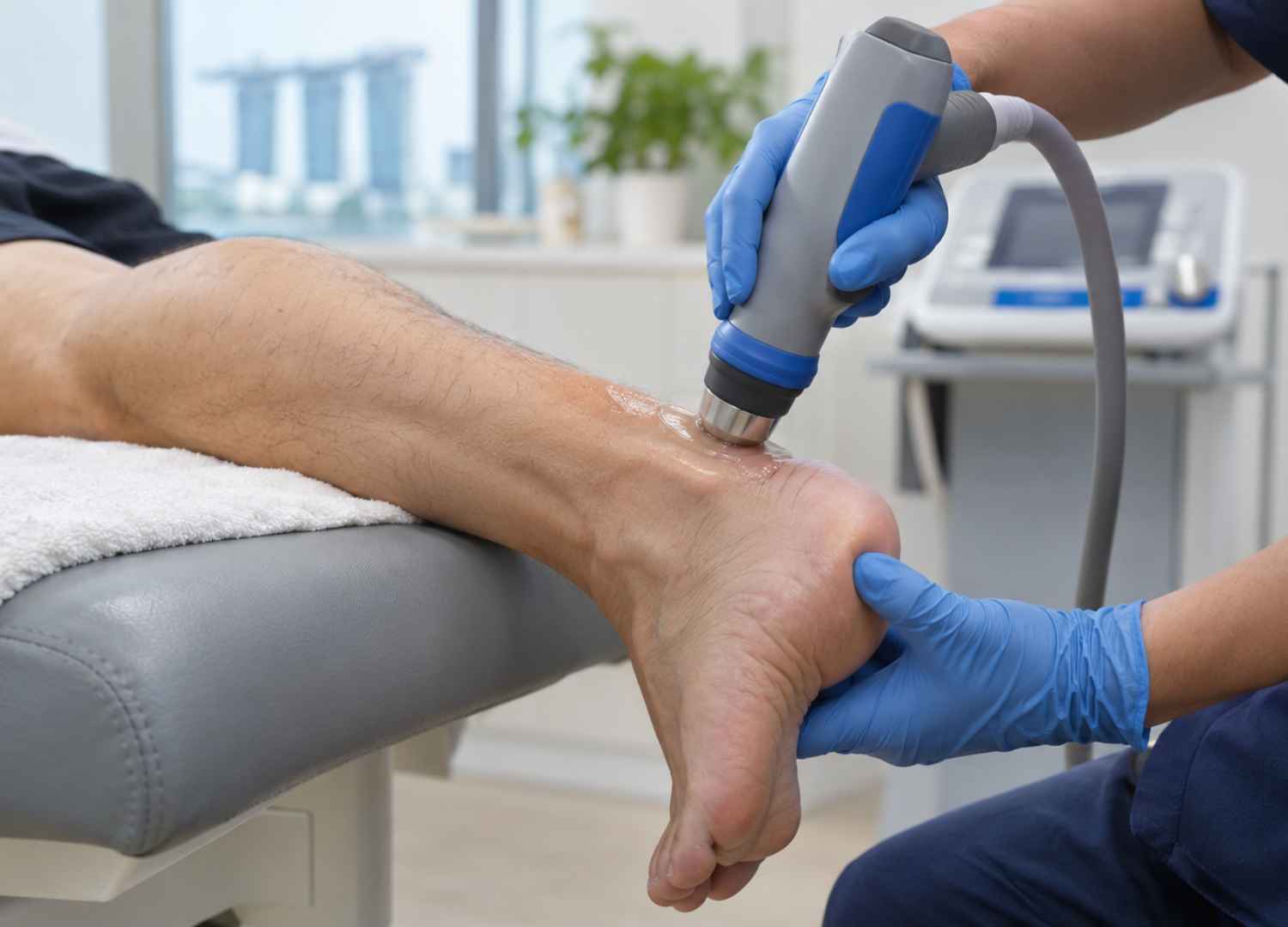
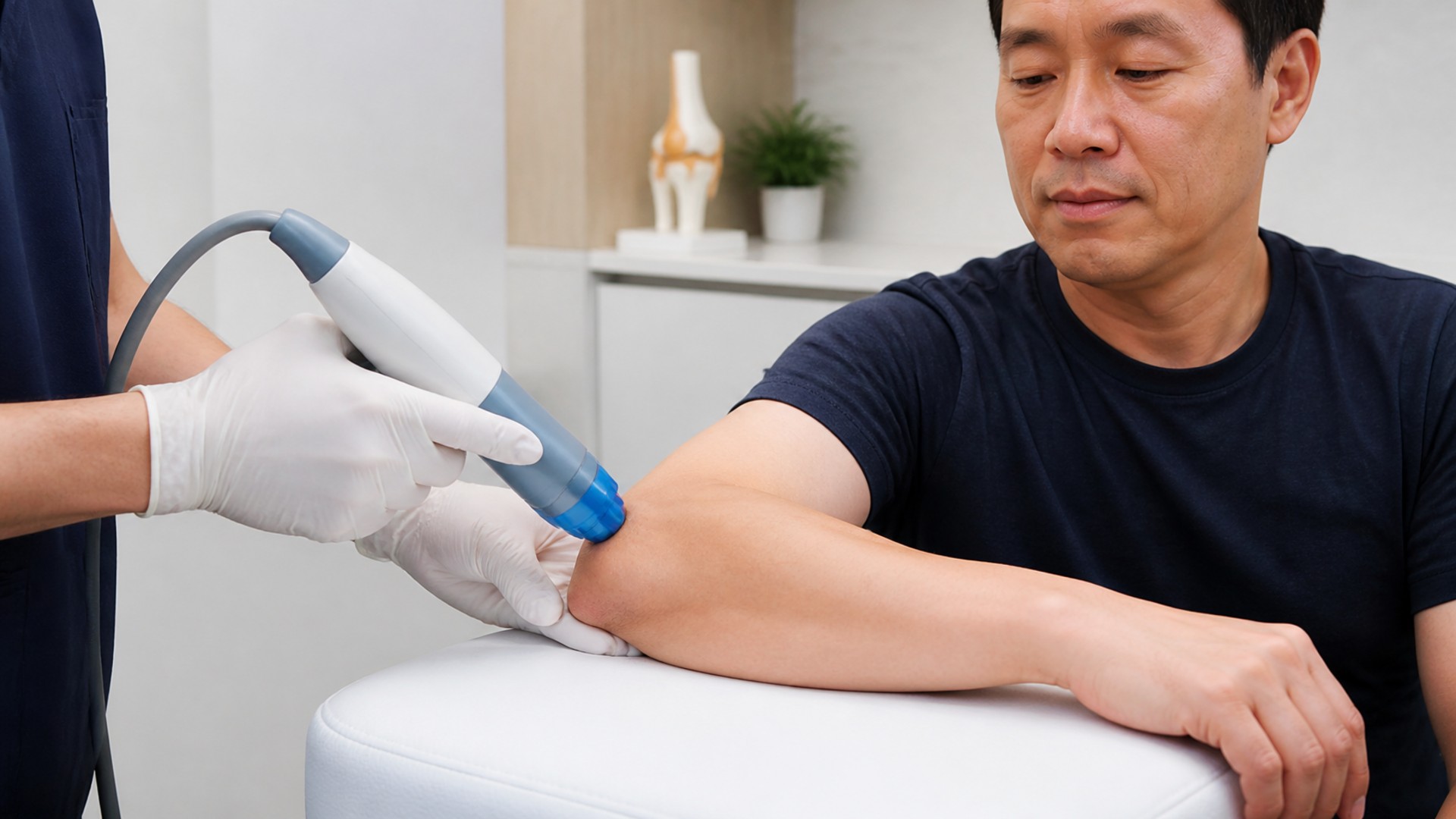
Before treatment, the doctor confirms the diagnosis and checks the patient’s medicines. Gel is applied to the outer elbow, and a handheld applicator is placed over the tender spot. Patients typically feel a strong tapping sensation, and the energy is adjusted to tolerance.
How Many Sessions of Shockwave Therapy Are Needed for Tennis Elbow?
Most courses involve three to five sessions, spaced about a week apart. Improvement usually builds slowly. Some patients notice easing after the first two sessions, while others feel the main change several weeks after the course ends. The doctor reviews progress before deciding whether more sessions would help.
Downsides and Side Effects
Side effects are usually mild and short-lived. In a placebo-controlled study on tennis elbow, the most common were skin redness (21.1%), pain (4.8%) and small bruises (3.0%). The main downsides are several visits, some discomfort and the chance that it does not help enough.
Exercises Alongside Treatment
Shockwave therapy works best as part of a plan. Gradual forearm strengthening helps the tendon adapt to load. It also helps to change activities that strain it, such as gripping a mouse tightly or carrying heavy bags palm down.
When Should You See a Doctor in Singapore?
See a doctor if outer elbow pain has not improved after two to three weeks. The same applies if it keeps returning or affects your work, sleep or sport. Earlier assessment helps confirm the cause and avoid months of trial and error.
Seek prompt medical attention if you notice:
- Severe pain or swelling after a fall or direct injury to the elbow
- Inability to straighten or bend the elbow
- A hot, red, swollen elbow, especially with fever
- Numbness, tingling or weakness in the hand or fingers
- Pain that wakes you at night and is not related to movement
- Elbow pain with neck pain or pain spreading down the arm
No referral is required to see a DR+ doctor, who can assess the elbow and advise whether shockwave therapy in Singapore is a suitable option.
Conclusion
Shockwave therapy for tennis elbow is a non-invasive option that may help when tendon pain has lasted for months and other care has not been enough. Results vary between patients, and it works best for carefully selected patients, with a confirmed diagnosis and a strengthening plan alongside it.
If your elbow pain is lingering, the first step is to find out exactly what is causing it. DR+ doctors are trained in the Painostic® pain assessment methodology and can discuss whether ESWT for tennis elbow fits your situation. Speak to a DR+ doctor to find out if this treatment is right for you.
Frequently Asked Questions
Does shockwave therapy work on tennis elbows?
Shockwave therapy can help some people with tennis elbow. Clinical trials have found improvements in pain and grip strength, particularly in long-standing cases that have not improved with rest and exercises. A 2019 meta-analysis found better pain and grip strength results than steroid injection after 12 weeks. Results vary between patients, so a doctor’s assessment can help decide whether it suits your condition.
Can shockwave heal tennis elbow?
Shockwave therapy aims to support healing rather than heal the tendon directly. The pulses may encourage new blood vessels and repair activity in a tendon that has stopped healing normally, and may reduce pain signals. The same approach is used for other long-standing tendon problems. Results vary, and the treatment usually works best with a strengthening programme and changes to the activities that strain the elbow.
How many shockwave therapy sessions are needed for tennis elbow?
Most courses of shockwave therapy for tennis elbow involve three to five sessions, spaced about one week apart. Each session usually lasts about 10 to 20 minutes. Improvement tends to build gradually over several weeks to a few months after the course. Your doctor will review your progress and advise whether further sessions are likely to help.
What are the downsides of shockwave therapy?
The main downsides of shockwave therapy are some discomfort during treatment, the need for several visits and the chance that it does not help enough. Common side effects include temporary skin redness, soreness and mild bruising, which usually settle within a few days. It is generally avoided in pregnancy, over areas of infection or cancer, and in people with bleeding disorders or a pacemaker.
Can you do too much shockwave therapy?
Additional sessions do not necessarily improve results. Tendons need time between sessions to respond, which is why treatments are usually spaced about a week apart. Higher energy levels can cause more discomfort and bruising, and extra sessions do not always add benefit. If there is little change after a full course, a doctor will usually reassess the diagnosis rather than simply continue treatment.
Is tennis elbow 100% curable?
Most people with tennis elbow improve over time, but recovery can be slow and no treatment works for everyone. Pain can last from six months to two years. Many people recover with activity changes and strengthening exercises, and some need further treatment. Pain can return if the tendon is overloaded again, so gradual return to activity and good technique matter.
What is the fastest way to get rid of tennis elbow?
There is no single fastest way to get rid of tennis elbow, as recovery depends on the cause and how long it has lasted. Reducing activities that strain the tendon and starting a guided strengthening programme are usually the first steps. Some treatments relieve pain quickly in the short term, while others support longer-term recovery. A doctor can help you choose an approach that fits your situation.
Is shockwave therapy better than a steroid injection for tennis elbow?
Neither is better for everyone. Studies suggest steroid injections often relieve pain faster in the first few weeks. Shockwave therapy may give better pain and grip strength results after three months. Steroid injection relief can fade over time. The right choice depends on how long you have had pain, your health and your goals, so it is best discussed with a doctor.
About DR+ Medical & Paincare
DR+ Medical & Paincare is a primary care GP clinic group under Singapore Paincare Holdings Limited, with 12 clinics across Singapore. DR+ GPs are trained in the Painostic® pain assessment methodology through the Singapore Paincare Academy. They offer pain care alongside general GP and family medicine services. No referral is required.
Medical Disclaimer: This article is intended for general informational purposes only and does not constitute medical advice. Please consult a qualified healthcare professional for diagnosis and treatment tailored to your individual condition.
Latest Articles