

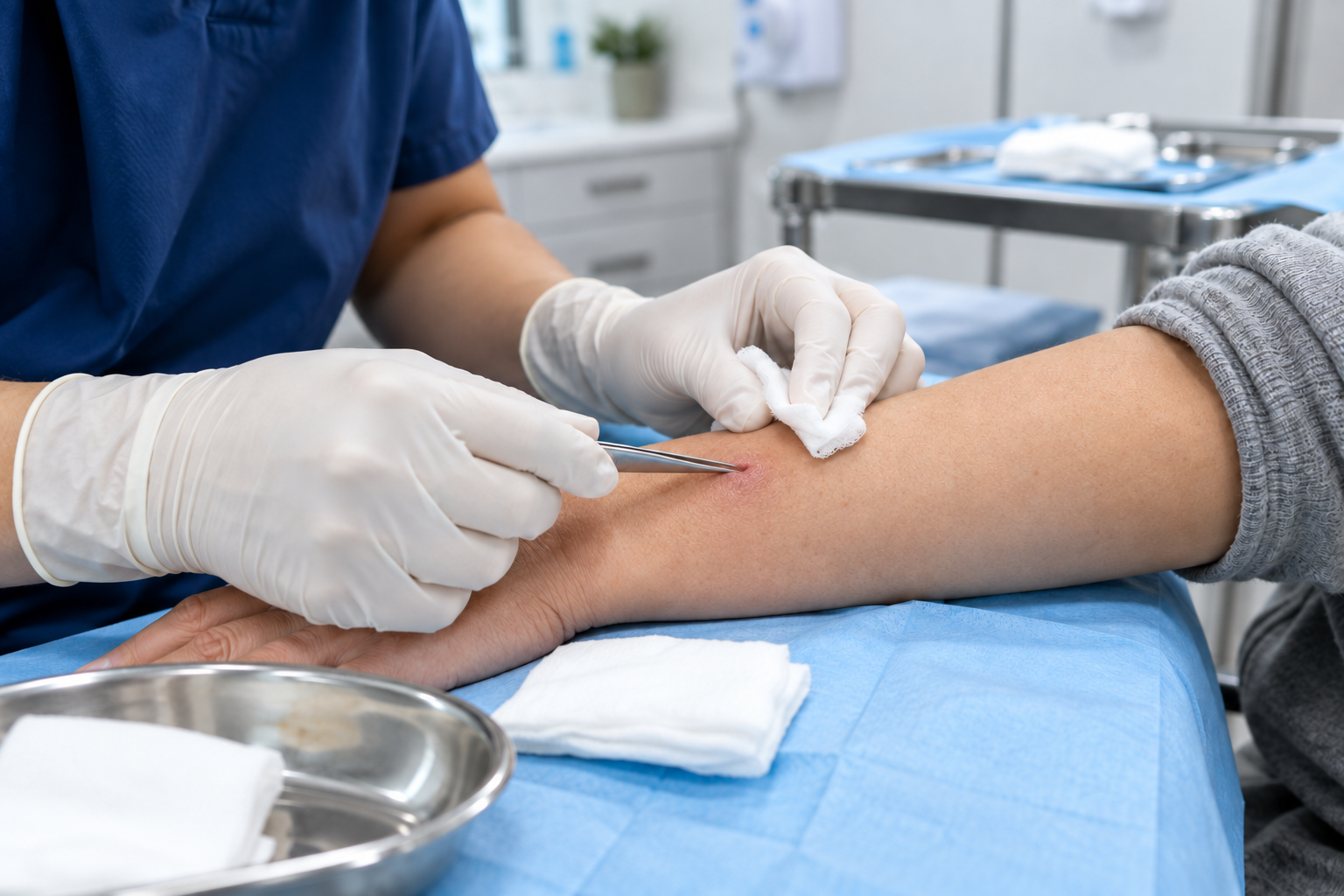
Minor Surgical Procedures
Incision and Drainage of Abscess in Singapore
A throbbing, swollen lump can make it hard to sit, sleep or get through the day. Our doctors can remove it under local anaesthetic, often on the same day, so your discomfort can start to ease.
Overview
Incision and drainage (I&D) is a minor procedure to treat a skin abscess, which is a painful collection of pus under the skin. The doctor makes a small cut to drain the pus. This relieves the pressure and lets the wound heal.
At DR+ Medical & Paincare, I&D is done in the clinic under local anaesthetic. It is often available on the same day, and MediSave may be used.
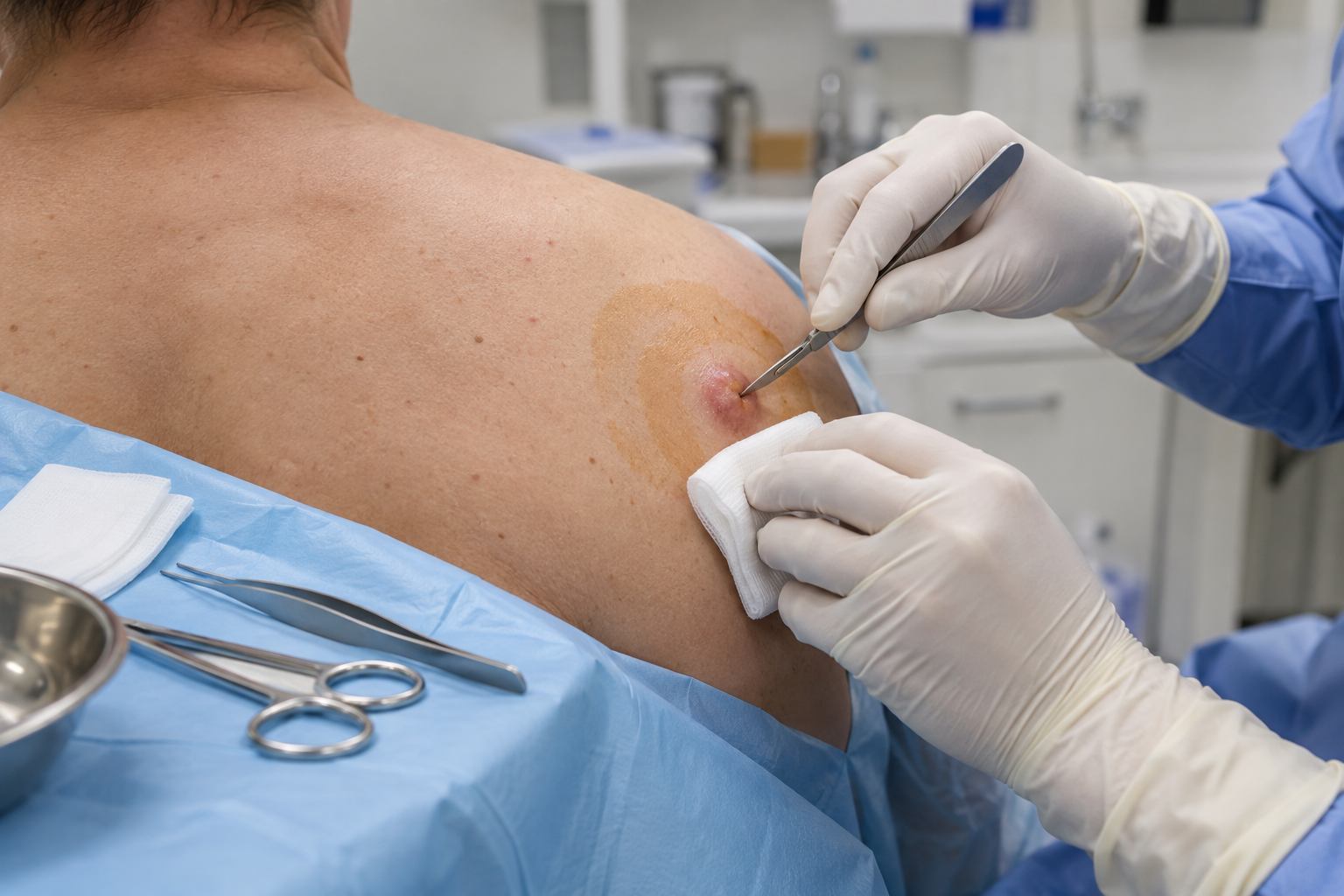
What Is Incision and Drainage (I&D)?
An abscess is a pocket of pus under the skin. It forms when the body fights a bacterial infection. It is often caused by a germ called Staphylococcus aureus (staph). The body builds a wall around the pus, so antibiotics alone often cannot clear it.
In incision and drainage, the doctor makes a small cut over the abscess to let the pus out, then cleans the space inside and covers it with a dressing. For most skin abscesses, drainage is the main treatment.
Signs You May Need Abscess Drainage
See a doctor if you notice any of these:
- A painful lump that is getting bigger, redder, warmer or more tense
- A soft centre, or a yellow or white head
- A boil that has not improved after about a week of warm compresses
- A lump larger than about 1 cm, or one that keeps coming back in the same place
- A mild fever, or feeling unwell, along with the lump
- A lump on the face, armpit, groin or buttock that makes it hard to move, sit or work
If the lump is still hard and has no soft centre, it may not be ready to drain yet. The doctor may start with antibiotics and warm compresses, then review it in a day or two.
Where Abscesses Form, and Which Ones a GP Can Treat
Many skin abscesses can be treated safely at your family clinic. Some need specialist intervention, and if this is the case, we will make prompt referral.
| Location | Notes |
|---|---|
| Armpit (Axillary Abscess) | Common with shaving and sweating. If it keeps coming back, it may be a skin condition called hidradenitis suppurativa. A referral to a skin specialist may help. |
| Buttock or Thigh (Gluteal Abscess) | Often linked to friction and sitting for long periods. |
| Back, Neck, Arms or Legs | Carbuncles are common on the back of the neck. |
| Groin | The doctor first checks how deep it is and if there are surrounding critical structures. |
| Face | Depends on the exact location. Abscesses near the nose and eyes need extra care. Some need a same-day referral. |
Some abscesses need specialist care, such as those around the anus, tailbone or breast, or very deep ones. If so, the doctor will arrange a referral. Tooth and gum abscesses should be seen by a dentist.
When to Go to A&E Instead
Go to the nearest emergency department, or call 995, if you have any of these:
- A high fever or chills, or you feel very unwell, drowsy or confused
- Redness that spreads quickly, or red streaks running from the lump
- Pain that is much worse than the lump looks
- Swelling around the eye
- A painful, swollen finger or hand that you cannot bend or straighten
- Signs of infection and poorly controlled diabetes, a weak immune system, or ongoing chemotherapy
Meet Dr Farah Khairi
DR+ Medical & Paincare Telok Blangah
MCR No: M63471I | MB BCh BAO (Ireland) | BCLS | ACLS
Dr Farah’s previous clinical rotations included General Surgery, Plastic Surgery, and Hand & Reconstructive Microsurgery. She can assess an abscess and advise whether drainage or another treatment approach may be appropriate.

What to Expect During Incision and Drainage at DR+?
Assessment
The doctor examines the lump and asks about your health, including diabetes, allergies and any blood thinners you take. The doctor then confirms if I&D is suitable, or if another option is better.
Cleaning and numbing
The skin is cleaned with antiseptic. Local anaesthetic is injected around the lump. You stay awake throughout.
Incision
Once the area is numb, the doctor makes a small cut over the softest part of the abscess.
Drainage
The pus is drained and the space/ cavity inside is gently rinsed. If the infection is large or keeps coming back, a wound swab may be sent to the lab to help select the appropriate
Dressing
A small abscess may only need a dressing. A deeper one may be lightly packed with gauze to help it keep draining as it heals.
Going home
You go home the same day with wound-care instructions, medicine if needed, and a date for your first wound check. Wound checks can be done at the DR+ clinic nearest to your home or workplace.
Do You Need Antibiotics After Drainage?
Not always. For a small, simple abscess, drainage alone often clears the infection. In clinical trials, adding antibiotics helped a little. Out of every 100 people, about 5 fewer had the treatment fail within a month. About 8 fewer had the abscess come back within three months. Antibiotics can also cause side effects, such as nausea and diarrhoea.
The doctor is more likely to prescribe antibiotics if:
- The abscess is large, or there is more than one
- The skin around it is red and spreading (cellulitis), or you have a fever
- You have diabetes or a weak immune system
- The abscess is on the face, hands or genitals
- The abscess has come back after an earlier drainage
If you are given antibiotics, finish the full course, even if you feel better.
Risks and Possible Complications
Incision and drainage is a common, low-risk procedure. As with any procedure, there are some risks:
- Pain or bleeding at the site
- The abscess coming back, especially if part of a cyst wall is left behind
- The infection spreading to the skin around it (cellulitis)
- A scar, which may be more visible in people who get keloids
- Rarely, an allergic reaction to the local anaesthetic or the dressing
The doctor will explain the risks that apply to you before starting.
Get Your Abscess Checked Today
Not sure if your boil needs draining? Our doctor can examine it and advise whether drainage, antibiotics or home care is right for you.
Abscess, Boil, Carbuncle or Infected Cyst: What Is the Difference?
These terms are often used to mean the same thing, but they are slightly different. The treatment can also differ.
| Condition | What It Is | Usual Treatment |
|---|---|---|
| Boil (Furuncle) | An infected hair root that forms a red, sore bump with a pus-filled head | Small boils may drain on their own with warm compresses. Large or painful boils may need I&D. |
| Carbuncle | A group of boils joined under the skin. It is common on the back of the neck, the back or the thighs. | Usually needs I&D. Antibiotics are more likely to be needed. |
| Skin Abscess | A bigger, deeper pocket of pus, often more than 1 cm across. It may feel soft or squishy when pressed. | I&D |
| Infected Cyst (Sebaceous or Epidermoid Cyst) | An existing cyst that has become infected and swollen | I&D first to clear the infection. The cyst can be removed a few weeks later, once it has settled, to lower the rate of recurrence. |
Why Do Abscesses Keep Coming Back?
Repeated boils or abscesses may have an underlying cause. Common causes include:
- Diabetes or prediabetes. High blood sugar makes skin infections more likely and slower to heal. A simple blood test called HbA1c can check for this. Read more in our diabetes guide.
- Carrying staph germs. Some people carry staph in their nose or on their skin without knowing it. The doctor may suggest a short course of antiseptic body wash or nose ointment.
- Friction, sweat and shaving, especially in the armpits, groin and buttocks
- Hidradenitis suppurativa. This long-term skin condition causes painful lumps in skin folds that keep coming back. A referral to a skin specialist may help.
- Excess weight, smoking or a weak immune system
Once the abscess has healed, we can check for these causes through chronic disease care, health screening and Healthier SG follow-ups.
Abscess Drainage Cost in Singapore
At DR+, incision and drainage of an abscess starts from S$250.
Note: This includes the local anaesthetic, dressings and other supplies. The fee is based on DR+ Telok Blangah rates and may differ at other clinics. The location and complexity of the abscess also affect pricing. Consultation, medicine and follow-up dressings are charged separately.
Is Abscess Drainage Medisave-Claimable?
MOH groups surgical procedures by code. Each code has a MediSave withdrawal limit set by CPF:
| Abscess Size | MOH Procedure Code (TOSP) | MediSave Limit |
|---|---|---|
| Under 3 cm | SA840S (Table 1A) | Up to S$240 |
| Over 3 cm | SA841S (Table 1B) | Up to S$420 |
Our clinic team can check if you can use MediSave and help with the claim. If you have company or personal insurance, check with your insurer. Some plans cover minor outpatient procedures.
Why Choose DR+ Medical & Paincare for Abscess Drainage?

Treated in one visit
No appointment or referral is needed. If the abscess is ready to drain, the doctor can often do it during the same visit.

Medisave Accepted
Our fees are published upfront, from S$250 with local anaesthetic and dressings included. Our clinic team can help you with the MediSave claim.

12 clinics islandwide.
Walk-in to a DR+ clinic near your home or workplace. Selected clinics are open until 10pm on weekdays and on weekends.

Your lifelong health partner
We look beyond the immediate problem, checking for underlying causes and supporting you with the right follow-up care.
Our Clinics

Singapore 730018
- Mon: 8:00am – 9:00pm
- Tue – Fri: 8:00am – 4:30pm, 7:00pm – 9:00pm
- Sat: 8:00am – 12:30pm
- Sun & PH: Closed
-
Kindly note that clinic’s last registration is 15 minutes before closing time.
-
(Last registration timing – Mon: 8:45pm, Tue – Fri: 4:15pm & 8:45pm, Sat: 12:15pm)
988 Upper Serangoon Rd, Singapore 534733
- Mon to Fri: 8:30am – 2:30pm, 6:00pm – 10:00pm
- Sat & Sun: 8:30am – 12:30pm
- PH: Closed
-
(Kindly note that clinic’s last registration is 15 minutes before closing time.)
- Mon & Wed: 8:30am – 3:30pm, 5pm – 8pm
- Tue , Thu & Fri: 8:30am – 3:30pm
- Sat: 8:30am – 12:30pm
- Closed on Sun & PH
-
(Kindly note that clinic’s last registration is 15 minutes before closing time.)

- Mon, Wed & Fri: 8:30am – 12:30pm, 1:30pm – 4:30pm, 6:00pm – 9:00pm
- Tue & Thu: 8:30am – 12:30pm, 1:30pm – 4:30pm
- Sat: 8:30am – 12:30pm
- Closed on Sun & PH
-
(Kindly note that clinic’s last registration is 15 minutes before closing time.)
- Mon – Fri: 9:00 am–5:30 pm
- Closed on Sat, Sun & PH
-
(Kindly note that clinic’s last registration is 15 minutes before closing time.)

Singapore 640221
- Mon to Fri: 8:00am – 4:00pm
- Sat: 8:00am – 12:00pm
Sun: Closed - PH: Closed
-
(Kindly note that clinic’s last registration is 15 minutes before closing time.)
- Mon & Tue: 9am to 1pm, 2pm to 4pm, 6:30pm to 9:30pm
- Wed, Thu & Fri: 9am to 1pm, 2pm to 5pm
- Sat: 9am to 1pm
- Closed on Sun & PH
-
(Kindly note that clinic’s last registration is 15 minutes before closing time.)

#01-54 The Midtown, Singapore 533971
- Mon & Tue: 8:00am – 12:30pm, 1:30pm – 5:00pm, 6:00pm – 9:00pm
- Wed: 8:00am – 12:30pm, 6:00pm – 9:00pm
- Thu: 8:00am – 12:30pm, 1:30pm – 5:00pm
- Fri: 8:00am – 12:30pm, 6:00pm – 9:00pm
- Sat: 8:00am – 12:00pm
- Sun & PH: Closed
(Kindly note that clinic’s last registration is 15 minutes before closing time.)

Thomson Imperial Court, Singapore 574424
- Mon to Wed: 8:30am – 10:00pm
- Thu: 8:30am – 3:00pm, 6:00pm-9:30pm
- Fri: 8:30am – 6:00pm
- Sat & Sun: 9:00am – 3:00pm
- PH: Closed
-
(Kindly note that clinic’s last registration is 15 minutes before closing time.)
Singapore 520844
- Mon, Tue, Thu, Fri: 8:00am – 4:00pm
- Wed: 8:00am – 4:00pm, 6:00pm – 9:00pm
- Sat: 8:30am – 12:30pm
- Sun & PH: Closed
-
-
(Our clinic is open during lunch hours)
#01-95, Singapore 570121
- Mon, Wed, Thu & Fri: 8:00am – 5:00pm, 6:00pm – 9:00pm
- Tue: 8:00am – 5:00pm
- Sat & Sun: 8:00am – 1:00pm
- PH: Closed
-
(Kindly note that clinic’s last registration is 15 minutes before closing time but may close earlier if the queue is unusually long.)
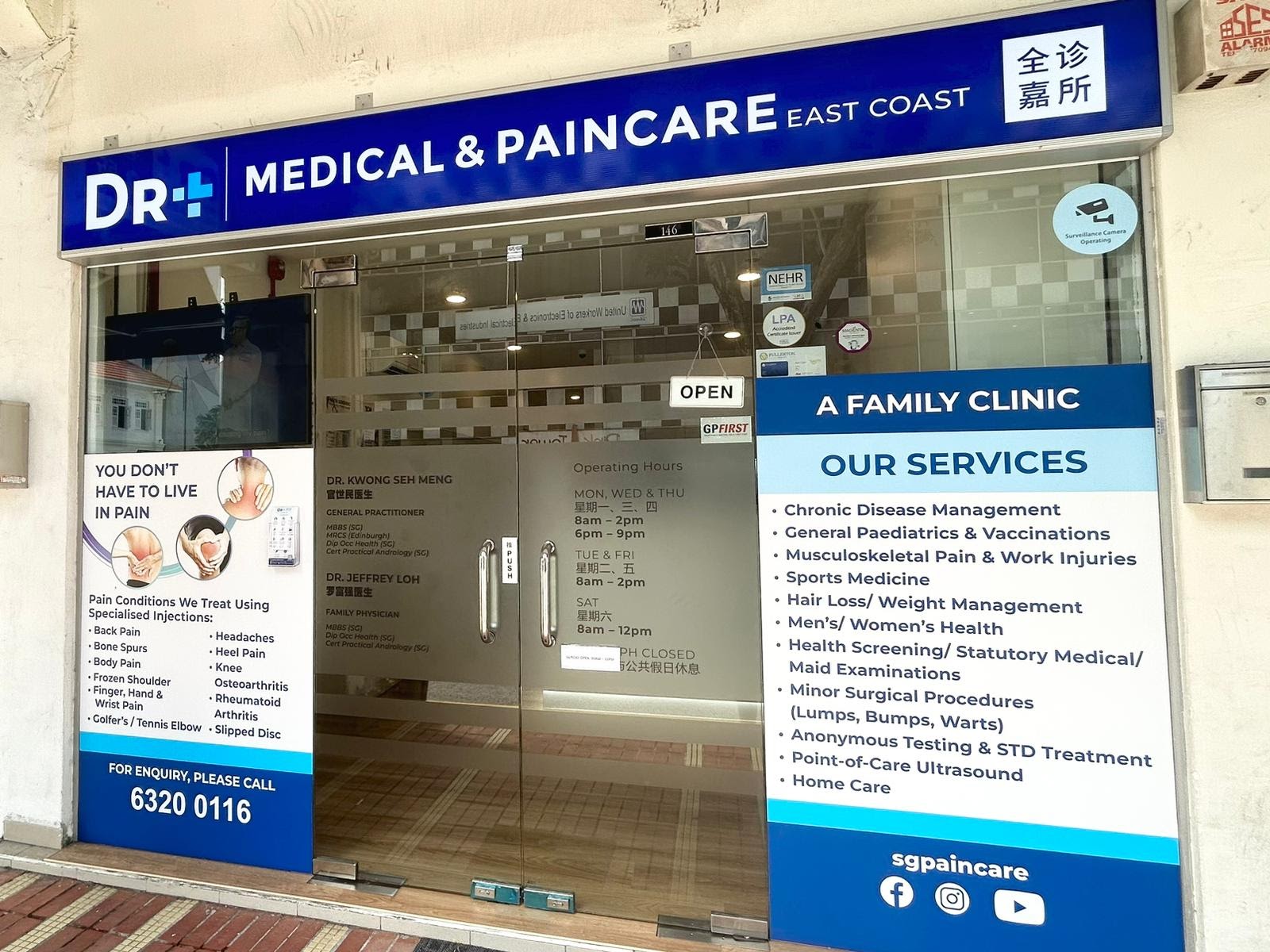
- Mon: 8:00am – 2:00pm, 6:00pm – 9:00pm
- Tue & Wed: 8:00am – 3:00pm
- Thu: 8:00am – 3:00pm, 6:00pm – 9:00pm
- Fri: 8:00am – 2:00pm
- Sat: 8:00am – 12:00pm
- Sun: 10:00am – 1:00pm
- PH: Closed
Frequently Asked Questions
How much does incision and drainage of an abscess cost in Singapore?
At DR+, incision and drainage starts from S$250, including local anaesthetic and dressings. Consultation and medicine are charged separately. MediSave can be used up to S$240 for abscesses under 3 cm (MOH code SA840S) and up to S$420 for abscesses over 3 cm (SA841S).
Can a GP drain an abscess?
Yes. Many skin abscesses on the arms, legs, back, armpits and buttocks can be drained safely by a GP under local anaesthetic. Deep or very large abscesses, and those around the anus, breast or tailbone, are usually referred to a specialist surgeon.
Can a walk-in clinic drain an abscess?
Yes. All DR+ clinics accept walk-ins during opening hours, and drainage can often be done on the same day. You can WhatsApp +65 8777 9500 to check the queue first.
Is abscess drainage a major surgery?
No. Incision and drainage of a skin abscess is a minor procedure done under local anaesthetic. The procedure takes about 10–20 minutes, and you go home the same day.
How painful is draining an abscess?
The local anaesthetic injection stings for a few seconds. Infected skin does not numb as well as normal skin, so you may feel some pressure or discomfort during drainage. Tell the doctor if you do, as more anaesthetic can be given. The throbbing usually eases once the pus is released.
How long does an abscess take to heal after incision and drainage?
Most wounds heal in 1–3 weeks. Small abscesses heal faster. Larger or packed wounds may take longer, as they heal from the bottom up.
Can an abscess go away without drainage?
A small boil may drain and heal on its own with warm compresses. A larger abscess usually needs to be drained, because antibiotics alone often cannot reach the pus inside
Will I need stitches after incision and drainage?
Usually not. The wound is normally left open so that any remaining pus can drain and the wound can heal from the inside out.
Will the abscess come back after it is drained?
Most abscesses heal fully after drainage. Some come back, especially infected cysts, pilonidal abscesses, and abscesses in people with diabetes or hidradenitis suppurativa. Treating the underlying cause lowers the risk.
Can I shower after abscess drainage?
Keep the dressing dry for the first 24–48 hours, or until your first wound check. After that, a quick shower is usually fine. Pat the area dry and put on a fresh dressing as advised.
Updated on 23 Sept 2026; Medically reviewed by Dr. Farah Khairi, MB BCh BAO (Ireland) | BCLS | ACLS
Need Advice On Your Condition?
Please fill out the form and we will be in touch with you shortly