CONTENTS
Quick Answer:
Shockwave therapy for Achilles tendonitis may help long-standing pain in the middle of the tendon, especially when it is combined with a calf strengthening programme. The evidence is weaker for pain where the tendon joins the heel bone. A doctor’s assessment can confirm which type you have and whether shockwave is a sensible next step.
If you have been diagnosed with Achilles tendonitis and the pain is still there after weeks of rest and stretching, you are not alone. Tendon pain often settles slowly. Many people start looking into shockwave therapy for Achilles tendonitis when simple measures stop helping.
It is a common problem in Singapore. Singapore’s National Sports Participation Survey 2022 found that 74% of residents aged 13 and above exercised at least once a week. Walking and jogging were the two most popular activities (Asia News Network). More time on park connectors and running tracks means more tired Achilles tendons.
This article explains what the research shows, who is likely to benefit and what treatment involves. It also explains why the exact location of your pain matters.
What Is Shockwave Therapy for Achilles Tendonitis?
Shockwave therapy for Achilles tendonitis is a non-invasive treatment that sends acoustic pressure waves through the skin into a painful Achilles tendon to stimulate healing. Its full name is extracorporeal shockwave therapy, or ESWT. “Extracorporeal” simply means the energy is applied from outside the body.
Shockwave aims to restart healing in a tendon that has stopped repairing itself properly. The pressure waves are thought to increase blood flow and calm overactive pain nerves. You may also see the term Achilles tendinopathy, which doctors use for long-standing tendon pain and which the research below uses too.
Does Shockwave Therapy Work for Achilles Tendonitis? What the Evidence Says
The honest answer is that it depends on where in the tendon your pain sits. Research splits Achilles tendinopathy into two types, and shockwave performs differently in each.
Mid-Portion Achilles Tendinopathy
Mid-portion pain sits in the body of the tendon, roughly 2 to 6 cm above the heel. A 2022 systematic review found moderate-quality evidence for this type. Adding shockwave to a tendon loading programme gave a meaningful improvement in pain and function (Sports Medicine Open, 2022). In other words, shockwave seemed to help alongside exercise, not instead of it.
Insertional Achilles Tendinopathy
Insertional pain sits right where the tendon attaches to the back of the heel bone. For this type, the same review found the evidence lacking, with no clear benefit over standard care. A 2026 review in the Journal of Orthopaedic & Sports Physical Therapy went further. It concluded that shockwave should not yet be a routine treatment for either type.
Taken together, shockwave is better seen as a second-line add-on for stubborn mid-portion pain. It is not a stand-alone fix, and results vary from person to person.
Mid-Portion or Insertional? Why the Location of Your Pain Matters
Because shockwave works differently in the two types, it helps to notice exactly where your Achilles tendon pain sits. The table below is a rough guide only and does not replace a proper examination.
| Feature | Mid-portion Achilles Tendonitis | Insertional Achilles Tendonitis |
|---|---|---|
| Where It Hurts | Middle of the tendon, 2 to 6 cm above the heel, often with a tender, thickened area | Back of the heel bone, where the tendon attaches |
| Common Triggers | Running, sudden jumps in training, hill work | Uphill walking, stairs, shoes that press on the heel |
| Often Seen In | Runners and active adults | Middle-aged adults and people who stand for long hours |
| How Shockwave Tends to Respond | Moderate evidence of benefit when combined with loading exercises | Weak evidence, so other options usually come first |
Pain underneath the heel, especially with your first steps in the morning, points more towards plantar fasciitis than an Achilles problem. Some people have more than one source of heel pain, which is one reason an examination is worthwhile.
Who May Benefit From Shockwave Therapy?
Shockwave tends to suit people whose Achilles pain has lasted about three months or more, despite a fair trial of rest, footwear changes and exercises. It is often considered for mid-portion pain. It also suits people who would like to try a non-invasive option first.
It is not right for everyone. A suspected tear in the tendon needs a different plan, so this must be ruled out first. Shockwave is also usually avoided during pregnancy and over an infection or open wound. It may not suit people with bleeding problems, those on some blood thinners, or anyone who recently had a steroid injection to the area. Your doctor will check your medical history before recommending it.
What to Expect During and After Shockwave Therapy for the Achilles
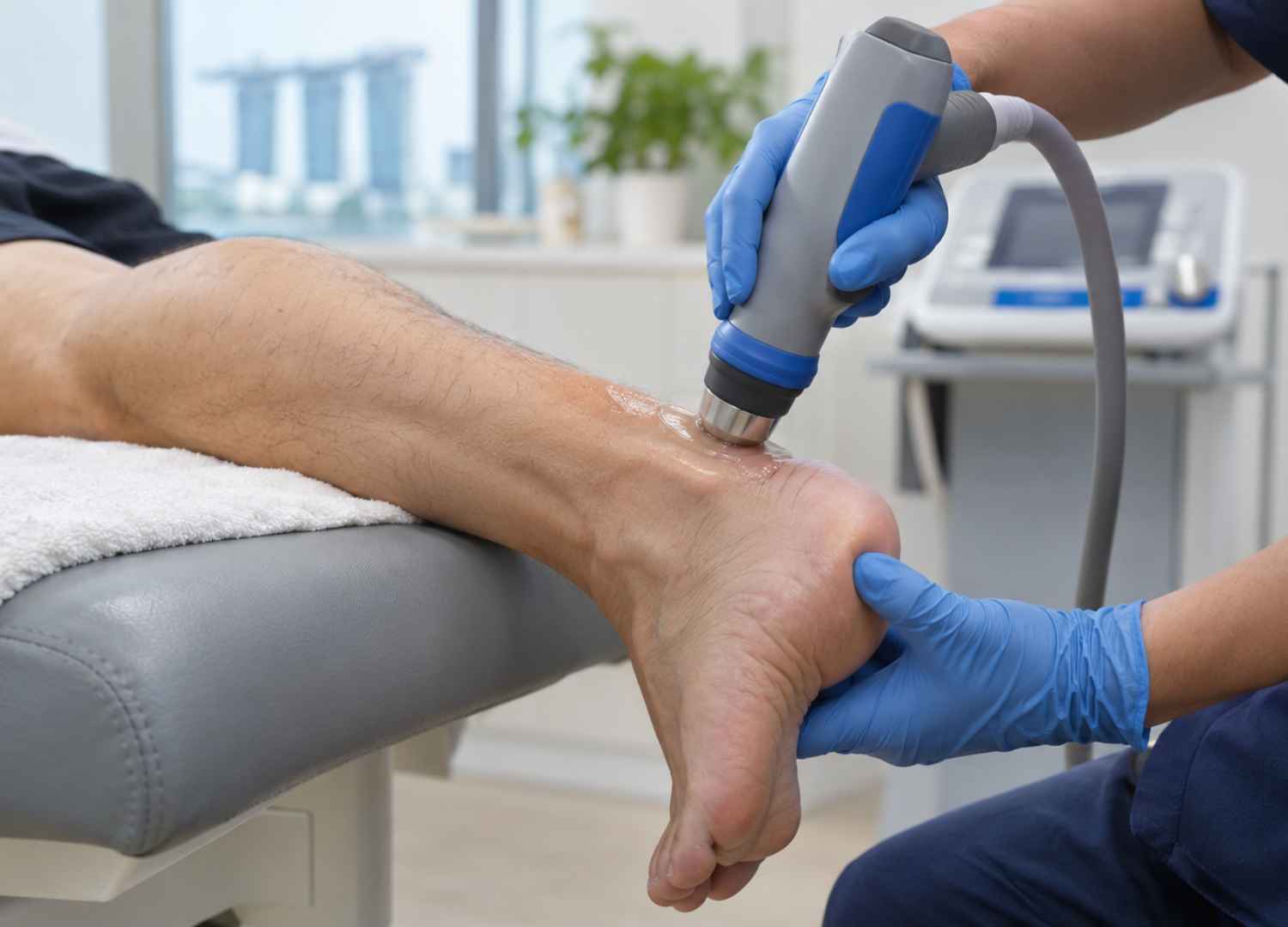
A typical session takes about 10 to 15 minutes. Gel is applied to the back of your lower leg. A handheld applicator then delivers pulses to the painful area while you lie face down.
How Many Sessions Will You Need?
Many treatment plans involve 3 to 5 sessions, spaced about a week apart. Improvement is usually gradual. It may take 6 to 12 weeks after the last session to judge the full effect, and you keep doing your strengthening exercises throughout.
Does It Hurt on the Achilles?
Most people describe a strong tapping or buzzing feeling. It can be uncomfortable over a tender tendon, but the intensity is adjusted to what you can tolerate. The discomfort stops when the session ends.
Can You Walk and Exercise Afterwards?
Yes. You can walk out of the clinic and carry on with your normal day. Many doctors suggest avoiding running, jumping and other high-impact exercise for about 48 hours afterwards.
Possible Side Effects
Side effects are usually mild and short-lived. They can include redness, tenderness, slight swelling or small bruises over the treated area for a day or two. At DR+ East Coast, shockwave can also be guided by point-of-care ultrasound (POCUS). This is a quick bedside scan used to find and mark the painful spot before treatment.
Where Shockwave Fits in Your Achilles Tendonitis Treatment Plan
Achilles tendonitis treatment should start with the right diagnosis and the least invasive options. Shockwave is one step in that plan, not the whole plan.
Physiotherapy and Tendon Loading Exercises
Gradual strengthening of the calf and Achilles tendon, such as heel raises built up over several weeks, is the foundation of care. Tendons adapt to load, so slowly increasing the work they do helps them become stronger and less painful. Rest alone rarely achieves this.
Extracorporeal Shockwave Therapy (ESWT)
When pain persists after a few months of loading exercises, shockwave therapy for Achilles tendonitis may be added. It suits many patients with mid-portion pain who want a non-invasive option. It works alongside your exercise programme rather than replacing it.
If Shockwave Is Not Enough
If your symptoms do not improve, your doctor will look at the diagnosis again. Where suitable, Coreflex Injections, part of our Myospan injections, may be considered for painful muscle or soft tissue around the tendon. They are not injected into the Achilles tendon itself. Patients who need specialist care may be referred to Singapore Paincare Center.
What Do Doctors Often See With Achilles Tendonitis Before Shockwave Therapy?
Doctor’s Insight
A common pattern among our patients is months of complete rest with little change. Weekend runners often stop all activity and wait for the pain to fade. So do people who stand on hard floors at work, such as retail or F&B staff. When they return, the pain comes straight back. Rest calms pain for a while, but it does not rebuild tendon strength. The tendon simply returns to work weaker than before.
A second pattern is mixing up two very different problems. A thickened, tender tendon that has been sore for months usually reflects wear and poor repair. A sudden sharp pain with a feeling of being kicked, followed by weakness when pushing off, raises concern for a partial tear. Both can sit in the same spot. However, the plan is completely different, and shockwave is not suitable for a suspected tear.
There is also the gap between mid-portion and insertional pain. Patients often assume shockwave will help both equally. In practice, the location of the pain shapes whether shockwave is likely to be worthwhile at all.
The takeaway is that assessment should come before treatment, not after it. A short examination, and an ultrasound scan where needed, helps confirm the type of tendinopathy and rule out a tear. That way, shockwave goes to the patients most likely to benefit, and others are guided to options that suit them better.
When Is It Time to Consider Shockwave Therapy?
It may be worth talking to a doctor about shockwave if your Achilles tendonitis has lasted more than three months. The same applies if pain is limiting your walking, work or exercise, or keeps coming back each time you restart activity. No referral is required to see a DR+ doctor at any of our 12 clinics across Singapore.
Seek urgent medical attention if you notice:
- A sudden pop or snap at the back of the ankle, or a feeling of being kicked
- Being unable to stand on tiptoe or push off when walking
- Sudden swelling or bruising around the tendon
- Redness, heat and fever over the area
- New tendon pain after a recent course of certain antibiotics (fluoroquinolones)
You can find out more about shockwave therapy at DR+, including POCUS-guided treatment at our East Coast clinic. Speak to a DR+ doctor to find out if this treatment is right for you.
The Bottom Line on Shockwave for Achilles Pain
Living with Achilles tendonitis that will not settle is frustrating, especially when it keeps you from your walks, runs or long shifts. Shockwave therapy may help, particularly for stubborn mid-portion pain, when it is combined with a structured strengthening programme. It is less likely to help insertional pain, and it is not suitable for a suspected tear. The key is knowing which problem you have before choosing a treatment.
Speak to a DR+ doctor in Singapore today to take the first step toward a clearer diagnosis.
Frequently Asked Questions
Does shockwave therapy really work for Achilles tendonitis?
It can help some people. Research shows moderate evidence that shockwave improves pain and function in mid-portion Achilles tendinopathy when it is added to a calf strengthening programme. Evidence for insertional pain, at the back of the heel bone, is weak. Results vary, so shockwave is usually considered after a few months of exercise-based care has not been enough.
What are the negative side effects of shockwave therapy?
Side effects are usually mild and short-lived. Some people notice redness, tenderness, slight swelling or small bruises over the treated area for a day or two. Discomfort during the session is common but is adjusted to your tolerance. Shockwave is generally avoided during pregnancy, over infections, in some people on blood thinners, and when a tendon tear is suspected.
Can you walk after shockwave therapy on foot?
Yes. Most people walk out of the clinic normally and return to everyday activities the same day. Doctors often suggest avoiding running, jumping and other high-impact exercise for about 48 hours afterwards. Your usual tendon strengthening exercises are normally continued during the course, unless your doctor or physiotherapist advises otherwise.
What’s the fastest way to heal Achilles tendonitis?
There is no instant fix, because tendons heal slowly. The approach with the strongest evidence is a gradual calf and Achilles strengthening programme, combined with sensible changes to training and footwear. Complete rest often delays recovery. For pain lasting several months, a doctor may suggest adding shockwave therapy. An early assessment helps you avoid weeks spent on the wrong treatment.
How many sessions of shockwave therapy are needed for Achilles tendonitis?
Many treatment plans involve 3 to 5 sessions, spaced about one week apart. Improvement is usually gradual, and the full effect is often judged 6 to 12 weeks after the final session. The exact number depends on how long you have had symptoms, where the pain sits and how your tendon responds. Your doctor will review your progress along the way.
Does shockwave therapy hurt on the Achilles tendon?
Shockwave over a sore Achilles tendon can feel uncomfortable, often like strong tapping or buzzing. The intensity is adjusted so that it stays tolerable, and it can be lowered during the session if needed. The discomfort stops once treatment ends. Some people feel mild aching or tenderness for a day or two afterwards.
About DR+ Medical & Paincare
DR+ Medical & Paincare is a network of 12 primary care clinics across Singapore, part of Singapore Paincare Holdings Limited. Our GPs are trained in pain assessment under the Singapore Paincare Academy and provide family medicine alongside pain management. No referral is required to see a DR+ doctor.
Medical Disclaimer
This article is intended for general informational purposes only and does not constitute medical advice. Please consult a qualified healthcare professional for diagnosis and treatment tailored to your individual condition.
Latest Articles