CONTENTS
Tennis elbow is common in people who play racquet sports or train at the gym. In our local population, it is often seen in badminton players, tennis players and gym-goers. Many rest for a few weeks, go back to playing, and find that the pain returns.
Rest alone rarely fixes it. Tennis elbow heals best when you reduce the strain, rebuild the tendon and return to sport step by step. Knowing how to heal tennis elbow correctly, and when it is safe to play again, matters as much as the treatment itself.
Tennis elbow (lateral epicondylitis) is an overuse injury of the tendon on the outer elbow. This tendon connects the muscles that bend your wrist and fingers backwards to the bony bump on the outside of the elbow. Despite its name, it is not limited to tennis players. It affects about 1 to 3% of adults and is most common between the ages of 40 and 50 (Bisset et al., BMJ Clinical Evidence).
This guide explains how long tennis elbow takes to heal, why sport strains the elbow, how to recover in stages, and how to return to sport safely.
How Long Does Tennis Elbow Take to Heal?
Tennis elbow usually heals within 6 to 12 months. How long yours takes depends on which stage you are in. Doctors group tennis elbow into two stages.
Early Tennis Elbow
Early tennis elbow is an irritated tendon that has not yet changed in structure. It usually follows a sudden jump in activity, such as a new racquet, extra matches or a heavier gym programme. It feels like a dull ache on the outer elbow that gets worse when you grip, lift or start playing. Most early cases settle within 6 to 12 weeks once you cut back the load.
Long-Standing Tennis Elbow
Long-standing tennis elbow develops after months of repeated strain. The tendon fibres become weaker and disorganised, a change called tendinosis (tendon degeneration). Pain may be present even at rest, and it tends to return each time you go back to sport. Recovery is slower and usually needs 3 to 6 months or more of structured strengthening.
Why Badminton, Tennis, Golf and Gym Training Strain the Elbow
Every time you grip a racquet, club or bar, the tendon on the outer elbow works to hold your wrist steady. Sports that involve repeated gripping put this tendon under constant load.
Racquet Sports: Badminton, Tennis and Pickleball
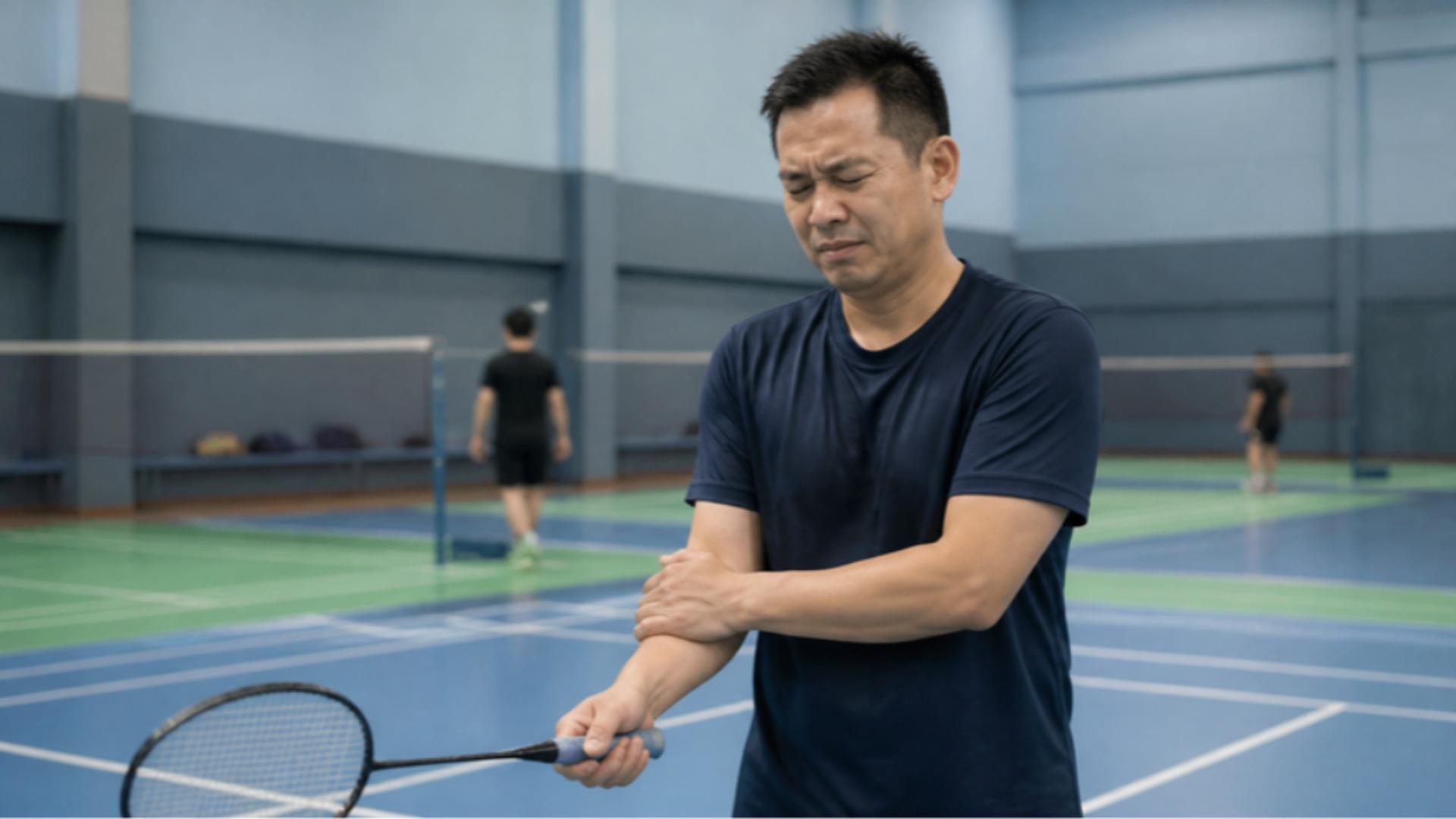
Badminton is popular in Singapore and a common cause of tennis elbow in recreational players. The strain usually comes from repeated backhand clears and wrist flicks played with a tight grip. In tennis and pickleball, a late or one-handed backhand puts the most load on the outer elbow. A grip that is too small, or strings that are too tight, add to the strain.
Golf
Golfers usually get tennis elbow in the lead arm (the left arm for a right-handed golfer). Hitting the ground or a hard driving range mat sends a sudden force up the forearm to the tendon.
Gym Training and Weightlifting
Tennis elbow from weightlifting is common if your programme has a lot of pulling exercises, such as pull-ups, rows, deadlifts and reverse curls. Elbow pain after gym sessions usually starts after a sudden increase in training volume or grip-heavy work.
Is It Tennis Elbow or Something Else?
Not all outer elbow pain is tennis elbow. Other conditions can feel similar, and where it hurts and what triggers it give useful clues. Use this table as a general guide, not a diagnosis.
| Condition | Where it hurts | Common triggers | Key feature |
|---|---|---|---|
| Tennis elbow | Outer elbow, on the bony bump | Gripping, lifting with palm facing down | Pain when you bend your wrist back against resistance |
| Radial tunnel syndrome (a trapped nerve) | A few centimetres below the outer elbow | Repeated twisting of the forearm | Aching in the forearm muscle, sometimes worse at night |
| Pain from the neck | Outer elbow and forearm | Neck movement or posture | Neck stiffness, tingling or numbness in the fingers |
How to Heal Tennis Elbow in 3 Stages
Tennis elbow heals best in 3 stages: settle the pain, rebuild the tendon, then return to sport. Complete rest is a common mistake. It may ease the pain for a while, but it also weakens the tendon, so the pain often comes back when you start playing again.
- Stage 1: Settle the pain (usually weeks 1 to 2). Cut back on activities that cause pain, but keep your arm moving. Lift with your palm facing up where you can, and take a short break from sport and grip-heavy gym exercises. A counterforce brace (a strap worn a few centimetres below the elbow) may reduce strain during daily tasks. Paracetamol or a short course of anti-inflammatory medication may help, if your doctor advises it.
- Stage 2: Rebuild the tendon (usually weeks 2 to 12). Start with isometric exercises (holding a muscle tight without moving the joint). For example, press the back of your hand up against your other hand and hold for 30 to 45 seconds, 4 to 5 times. When this is comfortable, move on to slow wrist extension with a light dumbbell, lowering over about 3 seconds, for 3 sets of 15. Then add grip strengthening and forearm rotation exercises.
- Stage 3: Return to sport (usually from week 6). Start with shadow swings or light drills. Build up to short rallies, then longer sessions, then competitive play. In the gym, bring back pulling exercises with lighter weights and a neutral grip first.
Your doctor or physiotherapist can adjust these exercises and timelines to suit you.
Can You Keep Playing With Tennis Elbow?
You can usually keep playing at a lower intensity, as long as the pain stays mild and settles quickly. A simple guide is to rate your pain from 0 to 10. Pain of up to 3 out of 10 during play is generally fine, as long as it settles by the next morning.
If the pain goes higher, or your elbow feels worse the next day, play for shorter periods or at a lower intensity. The same applies in the gym. Push-ups are usually fine because your palm is flat and your grip is relaxed. Pull-ups and heavy rows usually need to be cut back first.
Grip, Racquet and Technique Changes That Reduce Strain
Small changes to your equipment and technique can reduce the force on the tendon. A racquet grip that is too small makes you squeeze harder. Lowering your string tension by a few pounds may reduce vibration. A coach can also check your backhand, as a two-handed backhand in tennis or a looser grip in badminton reduces the load on the outer elbow.
In the gym, use lifting straps for heavy pulls and vary your grip. At work, keep your wrist straight on the keyboard and mouse, and take regular short breaks.
Can a GP Treat Tennis Elbow?
Yes. A GP is a good place to start for the assessment and treatment of tennis elbow. Diagnosis is usually based on your symptoms, medical history and a physical examination, and most people improve without surgery.
Your doctor will ask about your sport, work and daily activities, including when the pain started and which movements make it worse. They will then examine your elbow and may perform tests that place gentle tension on the affected tendon. These include Cozen’s test, which involves bending your wrist back against resistance, and Mill’s test, which stretches the tendon with your elbow straight and wrist bent forward. Your grip strength may also be measured as a baseline. Where needed, your doctor will check your neck and arm nerves for other possible sources of pain.
At DR+, our GPs are also trained in pain assessment. Every DR+ doctor is trained in the Painostic® methodology through the Singapore Paincare Academy. This helps your doctor find the likely source of your elbow pain and plan treatment to match.
Where suitable, point-of-care ultrasound (POCUS) may be used at selected DR+ clinics to support the assessment. This scan is done during your consultation and gives a closer view of the affected tendon, which lies just under the skin. It can show tendon changes such as thickening or tears, and helps rule out other causes of elbow pain.
At DR+ Alexandra, Dr Caleb Seet, who is trained in musculoskeletal ultrasound, may use POCUS as part of this assessment. The first scan can also give a baseline to track your recovery.
X-rays are not usually needed for tennis elbow, but may be considered after an injury or if a bone or joint problem, such as arthritis, is suspected. An MRI may be considered if symptoms persist despite treatment or the diagnosis remains unclear.
After the assessment, your GP can guide activity changes and rehabilitation exercises, refer you for physiotherapy, monitor your recovery, and discuss further treatment if symptoms persist.
Tennis Elbow Treatment at DR+ When Healing Stalls
If your elbow has not improved after 6 to 8 weeks of a structured plan, see a doctor to review the diagnosis and your treatment. Tennis elbow treatment at DR+ usually starts with the least invasive options.
Physiotherapy and a Structured Rehabilitation Plan
A structured strengthening programme is the foundation of treatment. A physiotherapist can progress your exercises, check your technique and plan your return to sport. Other treatments work alongside this programme, not in place of it.
Shockwave Therapy (ESWT)
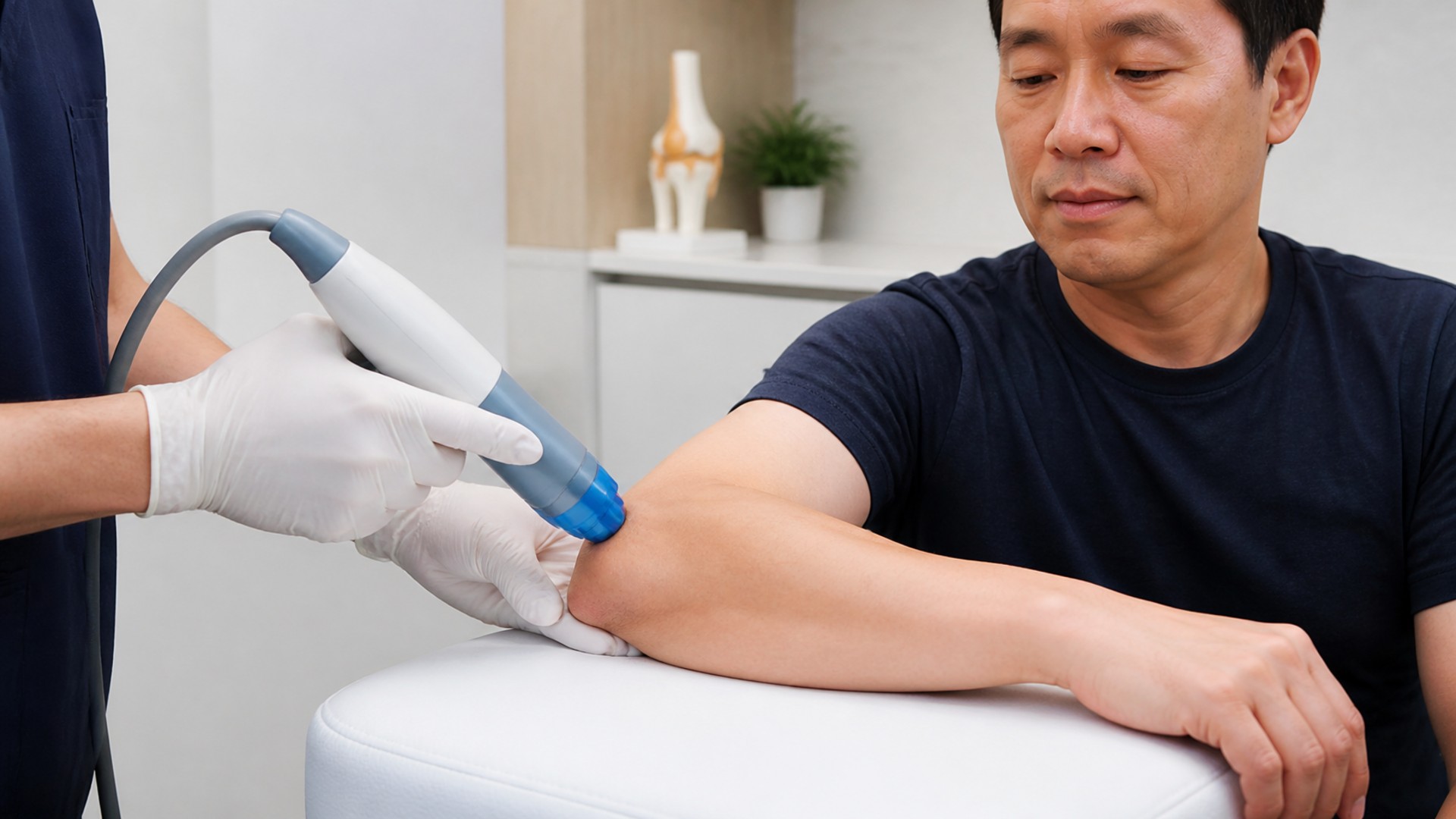
Shockwave therapy (ESWT) sends sound waves through the skin to the affected tendon to help it heal. It is non-invasive and does not involve needles. It may help if you have long-standing tendon pain that has not settled with exercise. It is usually given as a short course of sessions, about a week apart.
Coreflex Injections
Coreflex Injections combine a local anaesthetic, anti-inflammatory medication and a muscle relaxant, injected into the painful area. Pain relief may start soon after the injection as the local anaesthetic works. The full effect is usually felt from week 1 to week 3. At selected DR+ clinics, these injections can be guided by ultrasound for accurate placement. Injections do not rebuild the tendon, so they are combined with a strengthening programme. Your doctor will discuss how often they are suitable for you.
Referral to Singapore Paincare Center
If your pain continues despite these treatments, a DR+ doctor may refer you to Singapore Paincare Center for specialist assessment. Surgery is rarely needed for tennis elbow and is usually only considered after 6 to 12 months of non-surgical treatment.
What Does Dr Caleb Seet Often See in Sports Patients With Tennis Elbow?
Doctor’s Insight
Dr Caleb Seet, Accredited Family Physician at DR+ Alexandra with training in sports medicine and interventional pain medicine, highlights two patterns that often shape the treatment plan.
The first is that tennis elbow rarely comes from a single session. It usually follows a change in the past few weeks, such as a new racquet, tighter strings, an extra weekly game or a new pulling programme at the gym. Finding that change is often the most useful part of the history, because it shows how the load should be adjusted.
The second is the difference between the two stages. An early, irritated tendon often settles once the load is reduced. A long-standing tendon behaves differently. Many of these patients have rested for weeks, felt better, then had a flare on their first game back. Rest alone does not restore the tendon’s strength, so they need a gradual strengthening programme. Ultrasound helps here, because it shows how much the tendon has changed.
The key message is that early assessment usually means a simpler recovery. If your elbow still hurts after 6 weeks, or flares every time you go back to sport, have it checked rather than waiting it out.
When Should You See a Doctor for Tennis Elbow?
See a doctor if your elbow pain has lasted more than 6 to 8 weeks, keeps coming back when you play, or stops you from working, training or sleeping.
Warning signs: see a doctor promptly
- Swelling, warmth or redness around the elbow
- Numbness or tingling in the hand or fingers
- Pain that started after a fall or direct blow
- Severe pain at night or at rest
- Weakness, such as dropping objects
- An elbow that locks, catches or cannot fully straighten
For elbow pain without these warning signs, speak to a DR+ doctor in Singapore today to take the first step toward a clearer diagnosis.
Conclusion
Tennis elbow is common, and it is not something you simply have to play through. Most people recover once they reduce the strain, rebuild the tendon in stages and return to sport gradually. If your elbow is slow to improve, a GP can confirm the diagnosis, start treatment and refer you when needed.
If elbow pain is keeping you off the court or out of the gym, book a consultation with our DR+ team. You can visit DR+ Medical & Paincare Alexandra or any of our clinics islandwide.
Frequently Asked Questions
How do you heal tennis elbow naturally?
Most tennis elbow heals naturally with the right load and exercise. Cut back on activities that cause pain, but do not rest your arm completely. Start with isometric holds, then move to slow wrist strengthening and grip exercises over several weeks. A counterforce brace may ease strain during daily tasks. If there is no improvement after 6 to 8 weeks, see a doctor.
How long does tennis elbow take to heal?
Early tennis elbow often settles within 6 to 12 weeks once you reduce the activity that triggered it. Long-standing tennis elbow often needs 3 to 6 months or more of structured strengthening. Overall, most cases heal within 6 to 12 months. If your progress is slow, an assessment can help find out why.
Can a GP treat tennis elbow?
Yes. Most tennis elbow is diagnosed and treated by GPs. Your GP can confirm the diagnosis with a physical examination, rule out other causes, guide your rehabilitation and refer you for physiotherapy. DR+ GPs are pain-trained, and at selected clinics they may use point-of-care ultrasound where suitable. Treatments such as shockwave therapy or injections are also available. No referral is required.
Can typing cause tennis elbow?
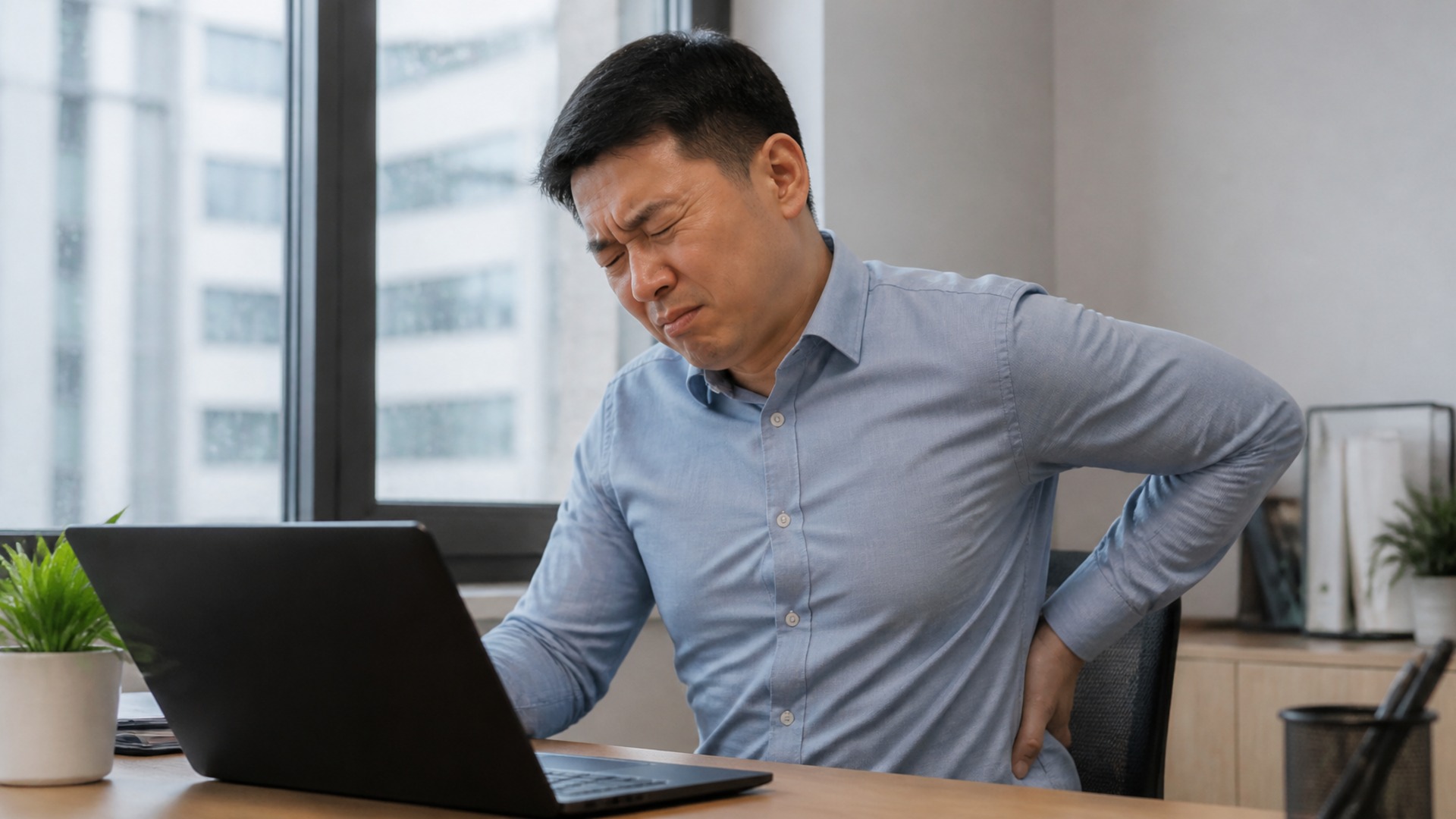
Typing and using a mouse can contribute to tennis elbow, as they use the same wrist muscles for long periods. On their own, they are less likely to cause it than repeated gripping and lifting. However, many people combine long hours at a desk with a racquet sport or gym training. Keeping your wrist straight and taking short breaks can help.
Should I wear my tennis elbow brace all the time?
You do not need to wear a tennis elbow brace all the time. It is most useful during activities that cause pain, such as lifting, gripping or playing sport. Take it off when resting and at night. A brace reduces strain on the tendon but does not rebuild strength, so use it together with a strengthening programme.
Can I do push-ups with tennis elbow?
Push-ups are usually fine with tennis elbow, because your palm is flat and your grip is relaxed. If they cause more than mild pain, try them on your knees or against a wall. Pull-ups, rows and other grip-heavy exercises usually need to be reduced first. Pain should stay mild and settle by the next day.
Will massage help tennis elbow?
Massage may relax tight forearm muscles and give short-term relief. However, it does not strengthen the tendon, which is the main goal of recovery. Use massage alongside a strengthening programme, not instead of it. Avoid deep, painful pressure directly on the bony bump of the outer elbow, as this can irritate the tendon further.
Is tennis elbow permanent?
Tennis elbow is not usually permanent. Most people recover within a year, and many recover sooner with the right management. In some people, symptoms last longer or come back when they return to the same activity too quickly. A gradual strengthening plan and changes to grip or technique can reduce the chance of it coming back.
About the Author
Dr Caleb Seet Yu Shiang is an Accredited Family Physician and the Medical Director of DR+ Medical & Paincare Alexandra. He holds an MBBS (NUS), a Graduate Diploma in Family Medicine (NUS/CFPS), a Graduate Diploma in Sports Medicine (NTU) and a Fellowship in Interventional Pain Medicine (Korea University). He is a Painostic® Trained Physician and is trained in musculoskeletal ultrasound, with more than 9 years of clinical experience. View Dr Caleb Seet’s profile.
About DR+ Medical & Paincare
DR+ Medical & Paincare is a network of 12 GP clinics in Singapore offering family medicine, chronic disease care and pain management. Our doctors are trained in the Painostic® methodology through the Singapore Paincare Academy. DR+ is part of Singapore Paincare Holdings Limited. No referral is required.
This article is intended for general informational purposes only and does not constitute medical advice. Please consult a qualified healthcare professional for diagnosis and treatment tailored to your individual condition.
Latest Articles