CONTENTS
Quick Answer:
Obesity is one of the biggest drivers of high blood pressure. Excess body fat, especially visceral fat around the waist, makes your heart pump harder, triggers hormones that hold on to salt and water, and keeps your nervous system on alert. Research estimates that excess weight accounts for about 65% to 75% of the risk of the most common type of high blood pressure. The link also works in reverse. Losing 5% to 10% of your body weight may help lower your blood pressure.
It often creeps up quietly. Your belt goes out a notch or two over a few years. Long hours at a desk, late dinners, and weekend hawker meals slowly add a few kilograms each year. Then a routine health screening shows a blood pressure reading of 148/94, even though you feel perfectly fine.
This story is increasingly common in Singapore. According to the Ministry of Health’s National Population Health Survey 2024, obesity among adults rose from 10.5% in 2019 to 2020 to 12.7% in 2023 to 2024. Over the same period, about 1 in 3 adults, 33.8%, had high blood pressure. The two are closely connected. In a study of 925 adults with high blood pressure at Singapore polyclinics, published in the Journal of Clinical Hypertension in 2019, 77.4%, or nearly 8 in 10, were overweight or obese by Asian BMI cut-offs. High blood pressure is one of the most common health problems linked to excess weight, and it often appears years before heart disease or stroke.
The encouraging part is that the link works in both directions. Losing excess weight usually lowers blood pressure, and for some people it may be enough to bring readings back into the healthy range or reduce the need for medication. How much it helps varies from person to person, which is why a proper assessment matters. This article explains what counts as obesity in Singapore, how it raises your blood pressure, which warning signs to look for, and what weight-focused treatment options are available.
What Counts as Obesity in Singapore?
Obesity means carrying enough excess body fat to harm your health. Doctors usually start with your body mass index (BMI), which is your weight in kilograms divided by your height in metres squared.
Singapore uses lower BMI cut-offs than many Western countries. This is because Asians tend to develop weight-related conditions, such as high blood pressure and type 2 diabetes, at a lower BMI. A BMI of 18.5 to 22.9 is considered healthy. A BMI of 23 to 27.4 carries moderate health risk, and a BMI of 27.5 or above carries high risk. Under the Western cut-off of 30, many Singaporeans at real risk would be missed.
BMI is only part of the picture. Your waist size also matters. A waist of 90 cm or more in men, or 80 cm or more in women, signals higher risk to your heart and metabolism, even if your BMI looks acceptable. You can read more about how obesity is defined, diagnosed, and linked to other conditions on our obesity page.
How Does Obesity Cause High Blood Pressure?
Doctors consider obesity one of the strongest risk factors for high blood pressure. A review in the journal Circulation Research in 2015 estimated that excess weight accounts for about 65% to 75% of the risk of primary hypertension, the most common type of high blood pressure. Local data shows the same pattern. The Well-being of the Singapore Elderly study, which looked at 2,488 residents aged 60 and above, found that high blood pressure affected 66.3% of those with a healthy BMI, 78.1% of those with a BMI of 23 to 27.4, and 81.2% of those with a BMI of 27.5 or above. After accounting for other factors, people in the highest BMI group were about twice as likely to have high blood pressure as those at a healthy weight.
Several processes are at work, and they tend to strengthen one another.
Your Heart Has to Pump More Blood
More body tissue needs more blood flowing to it. Your heart meets this demand by pumping a larger volume of blood with each beat. More blood moving through the same arteries means higher pressure against their walls.
Fat Tissue Tells Your Kidneys to Hold On to Salt
Excess fat, especially visceral fat, switches on a hormone system called the renin-angiotensin-aldosterone system. This tells your kidneys to keep more salt and water in your body. Visceral fat can also press on the kidneys directly. The extra fluid raises your blood pressure. This is why salt tends to hit harder when you carry extra weight, and salt intake is already high here. Singapore’s National Nutrition Survey 2022 found residents eat about 3,620 mg of sodium a day on average, well above the recommended limit of under 2,000 mg.
Your Nervous System Stays on Alert
Obesity raises the activity of your sympathetic nervous system, the “fight or flight” system that speeds up your heart and tightens your blood vessels. When it stays switched on for long periods, your blood pressure stays up too.
Insulin Resistance Builds Up
Many people with obesity develop insulin resistance, where the body stops responding well to insulin. High insulin levels make your kidneys hold on to more salt. Insulin resistance is also an early step towards type 2 diabetes, which damages blood vessels further.
Extra Weight Disrupts Your Sleep
Fat around your neck can narrow your airway during sleep, causing obstructive sleep apnoea. Each time your breathing pauses, your oxygen drops and your blood pressure spikes. Over months and years, this can keep your blood pressure high during the day as well.
Does Belly Fat Raise Blood Pressure More Than Other Fat?
Yes. Fat stored deep inside your abdomen, called visceral fat, is more closely linked to high blood pressure than fat on your hips, thighs, or just under your skin. This means your waist size can reveal blood pressure risk that your weight or BMI alone may miss. In the Singapore polyclinic study mentioned earlier, 71.8% of adults with high blood pressure had a waist measurement in the higher-risk range.
| Feature | Visceral Fat (Belly Fat) | Subcutaneous Fat |
|---|---|---|
| Where It Sits | Deep inside the abdomen, around the liver, kidneys, and intestines | Just under the skin, including the hips, thighs, and arms |
| What It Does | Releases hormones and inflammatory substances into the bloodstream | Mainly stores energy and is less active |
| Link to High Blood Pressure | Strong | Weaker |
| How It Shows Up | A larger waist, often with a “firm” belly | Soft fat you can pinch |
What Is Visceral Fat?
Visceral fat is the fat packed around your internal organs. You cannot pinch it, because it sits behind your abdominal muscles. A person can look only slightly overweight and still carry a large amount of it.
Why Does Visceral Fat Raise Blood Pressure?
Visceral fat behaves more like an active organ than a simple fat store. It releases substances that trigger the salt-retaining hormones, nervous system activity, and insulin resistance described in the section above. Because it sits close to the kidneys, it can also press on them and make them hold on to more salt and water.
Can You Have High Blood Pressure From Belly Fat With a Normal BMI?
Yes. Some people have a BMI in the healthy or only mildly raised range but carry most of their weight around their middle. They can still develop high blood pressure, high blood sugar, and fatty liver. This pattern is common in Asian adults, which is one reason Singapore doctors check waist size as well as BMI.
How Can You Tell If You Have Too Much Belly Fat?
The simplest check is your waist measurement. Measure around your bare abdomen, midway between your lowest rib and the top of your hip bone, after breathing out normally. In Singapore, a waist of 90 cm or more in men, or 80 cm or more in women, signals higher risk to your heart and metabolism. Your doctor may also use body composition tests to estimate visceral fat more closely.
Does Belly Fat Go Down When You Lose Weight?
Usually, yes. Visceral fat tends to respond well to weight loss, often shrinking proportionally more than fat elsewhere in the body. This may be one reason why even a modest weight loss of 5% to 10% can make a noticeable difference to blood pressure.
What Are the Risks When Obesity and High Blood Pressure Occur Together?
Obesity and high blood pressure each raise your risk of heart disease on their own. Together, the risk builds further. High pressure damages the lining of your arteries over time, and the metabolic effects of excess fat make it easier for fatty plaque to build up and narrow them.
Left unmanaged, this can lead to heart attack, stroke, heart failure, and chronic kidney disease. Obesity and high blood pressure also tend to appear alongside high cholesterol and high blood sugar. Doctors call this cluster metabolic syndrome, and it raises cardiovascular risk more than any one factor alone.
None of this happens overnight. There is usually a long window, often many years, in which bringing your weight down may lower these risks.
Warning Signs That Your Weight Is Affecting Your Blood Pressure
High blood pressure itself rarely causes symptoms. In Singapore’s 2022 National Population Health Survey, more than half (53%) of adults found to have high blood pressure had not been diagnosed before. So the most useful warning signs often come from your weight and lifestyle, not from how you feel.
Watch for a waist that has grown past 90 cm for men or 80 cm for women, steady weight gain over several years, loud snoring or waking up unrefreshed, getting breathless more easily on stairs, and borderline results for blood sugar or cholesterol at a past screening. If you already know your blood pressure, a reading of 130/85 mmHg to 139/89 mmHg is considered “high-normal” in Singapore. It is an early sign worth acting on. A clinic reading of 140/90 mmHg or higher on repeated checks, or 135/85 mmHg or higher at home, meets the threshold for high blood pressure under the Agency for Care Effectiveness (ACE) clinical guidance on hypertension.
Very high blood pressure can occasionally cause symptoms that need urgent attention.
⚠ Seek urgent medical care if you have high blood pressure and experience any of the following:
- Chest pain or tightness
- Sudden severe headache, unlike your usual headaches
- Sudden weakness, numbness, or drooping on one side of the face or body
- Difficulty speaking, confusion, or sudden changes in vision
- Severe breathlessness
- A home reading of 180/120 mmHg or higher, especially with any of the symptoms above
Reading Your Own Pattern
Looking at how your weight and blood pressure have changed over time can help you have a more useful conversation with your doctor.
If your blood pressure has risen slowly over several years alongside gradual weight gain around your middle, the link to your weight is usually strong. People in this group often see their blood pressure improve as their weight comes down. If you also snore loudly or wake up tired, sleep apnoea may be adding to the problem. On the other hand, if your blood pressure is high even though your weight has been stable, rose suddenly, or appeared at a young age without much weight gain, your doctor may look for other causes, such as kidney or hormonal conditions.
Age is not the protection many people assume. Young adults in their 20s and 30s with obesity can develop high blood pressure, and so can children and teenagers who are significantly overweight. Because young people rarely get checked, it is often picked up late.
This kind of self-reflection is a helpful starting point. It is not a substitute for a proper assessment.
What Are the Treatment Options for Obesity and High Blood Pressure?
Losing weight is one of the most effective ways to lower blood pressure without medication, and you do not need to reach an “ideal” weight to benefit. Research shows that every kilogram you lose may lower your blood pressure by about 1 point. A realistic first goal is to lose 5% to 10% of your body weight, which is around 5 to 9 kg if you weigh 90 kg.
There are two main treatment routes. For most people, the first-line option is a GP-supervised weight management programme. For people with severe obesity who have not lost enough weight through a programme, bariatric surgery may be considered. Results vary from person to person, and your doctor will recommend the route that suits your health.
Obesity Treatment Option 1: GP Weight Management Programme for High Blood Pressure
A GP-led weight management programme is designed to help you reach a realistic weight-loss goal while keeping your blood pressure in view throughout. It is medically supervised and tailored to your condition, and usually includes the following.
Assessment and Blood Tests
The programme starts with a review of your medical history, weight history, and previous weight-loss attempts. Your doctor measures your BMI, waist circumference, and blood pressure. Where clinically appropriate, blood tests check metabolic and hormonal factors, such as blood sugar, cholesterol, and thyroid function. This sets your starting baseline and shows how much your weight may be contributing to your blood pressure.
Individualised Nutrition and Physical Activity Guidance
You receive nutrition and activity guidance tailored to your routine, health, and blood pressure. For blood pressure, this usually means eating fewer calories while also cutting down on salt, and building up activity gradually from a level that is safe for you. Advice can take into account how you actually eat, including hawker food and meals out.
Assessment and Management of Weight-Related Conditions
Excess weight often comes with other conditions, such as high blood pressure, type 2 diabetes, heart disease, and hormonal conditions like polycystic ovary syndrome (PCOS) or thyroid problems. These are assessed and managed as part of the same plan, because some can make weight harder to lose. If you are already on blood pressure medication, it continues alongside the programme, and your conditions can be followed up through regular chronic disease management reviews.
Prescription Weight Management Options
Where medically suitable, your doctor may discuss prescription weight management medication. In Singapore, this is generally considered if your BMI is 30 or above, or 27.5 or above with a weight-related condition such as high blood pressure. If started, medication is usually introduced at the lowest suitable dose and always used alongside nutrition and activity changes. Suitability, benefits, and side effects vary from person to person.
Regular Monitoring and Adjustments
In the first few months, reviews are typically held monthly. Your blood markers, waist circumference, and blood pressure are checked, and your plan is adjusted based on how your body responds. As your weight comes down, your doctor may also review your blood pressure medication. Never stop or change your medication without speaking to your doctor first.
Long-Term Maintenance Plan
From around the third month onwards, your health markers are compared with your starting baseline, and a long-term plan is agreed to help you maintain your progress. Keeping the weight off is what keeps the blood pressure benefit going.
Obesity Treatment Option 2: Bariatric Surgery for Severe Obesity
For people with severe obesity, weight loss surgery, also called bariatric or metabolic surgery, may be considered when a structured weight management programme has not been enough. In Singapore, it is generally considered for Asian adults with a BMI of 37.5 or above, or 32.5 or above with conditions such as high blood pressure, type 2 diabetes, or sleep apnoea.
Common procedures reduce the size of the stomach, and some also reroute part of the small intestine. This limits how much you can eat and changes the gut hormones that control hunger. Because it can lead to larger and longer-lasting weight loss, surgery may also lower blood pressure, and some people are able to reduce their blood pressure medication afterwards. Surgery carries its own risks and requires lifelong follow-up, including nutrition monitoring.
Bariatric surgery is carried out in hospital by specialist surgical teams. Your GP can assess whether you meet the criteria, discuss whether a referral is worth considering, and continue to manage your blood pressure and other conditions before and after surgery.
A Doctor’s Perspective
In clinic, two patterns come up again and again with weight-related high blood pressure.
The first is the working adult in their 30s or 40s whose weight has crept up by a kilogram or two each year, mostly around the middle. Their high blood pressure is found by chance at a company screening. When we look back, earlier screenings often showed a high-normal reading or a borderline blood sugar that nobody acted on. For this person, the blood pressure is really a sign of the weight problem. Treating the weight and visceral fat as the main target, rather than reaching straight for a blood pressure pill, may for some delay or reduce the need for long-term medication.
The second is the patient who has been on blood pressure medication for years. The dose has gone up, sometimes a second medicine has been added, yet the readings stay stubbornly high. Meanwhile their weight has kept rising, and nobody has asked about their snoring. In these patients, addressing the weight and screening for sleep apnoea can change the picture more than another adjustment to the medication.
The message in both cases is the same. When obesity is behind high blood pressure, the blood pressure reading is only the visible part of the problem. The earlier the weight itself is assessed and addressed, the more options you are likely to have.
Practical Steps You Can Take Day to Day
Small changes, kept up over time, tend to work better than crash diets. At the hawker centre, choose dishes with more vegetables and lean protein, ask for less rice, gravy, or sauce, and leave most of the soup, where much of the salt sits. Swap sweetened drinks for water or plain tea, or ask for “siu dai” if you do order one. When buying groceries, look for the Healthier Choice Symbol. Add a short walk after meals, take the stairs for a few floors, or get off the bus one stop early. Aim for seven to eight hours of sleep, since poor sleep makes both weight loss and blood pressure control harder. If you drink alcohol, keep to no more than two standard drinks a day for men and one for women, as advised by the Singapore Heart Foundation, since alcohol adds calories and raises blood pressure. If you smoke, stopping protects your blood vessels whatever your weight.
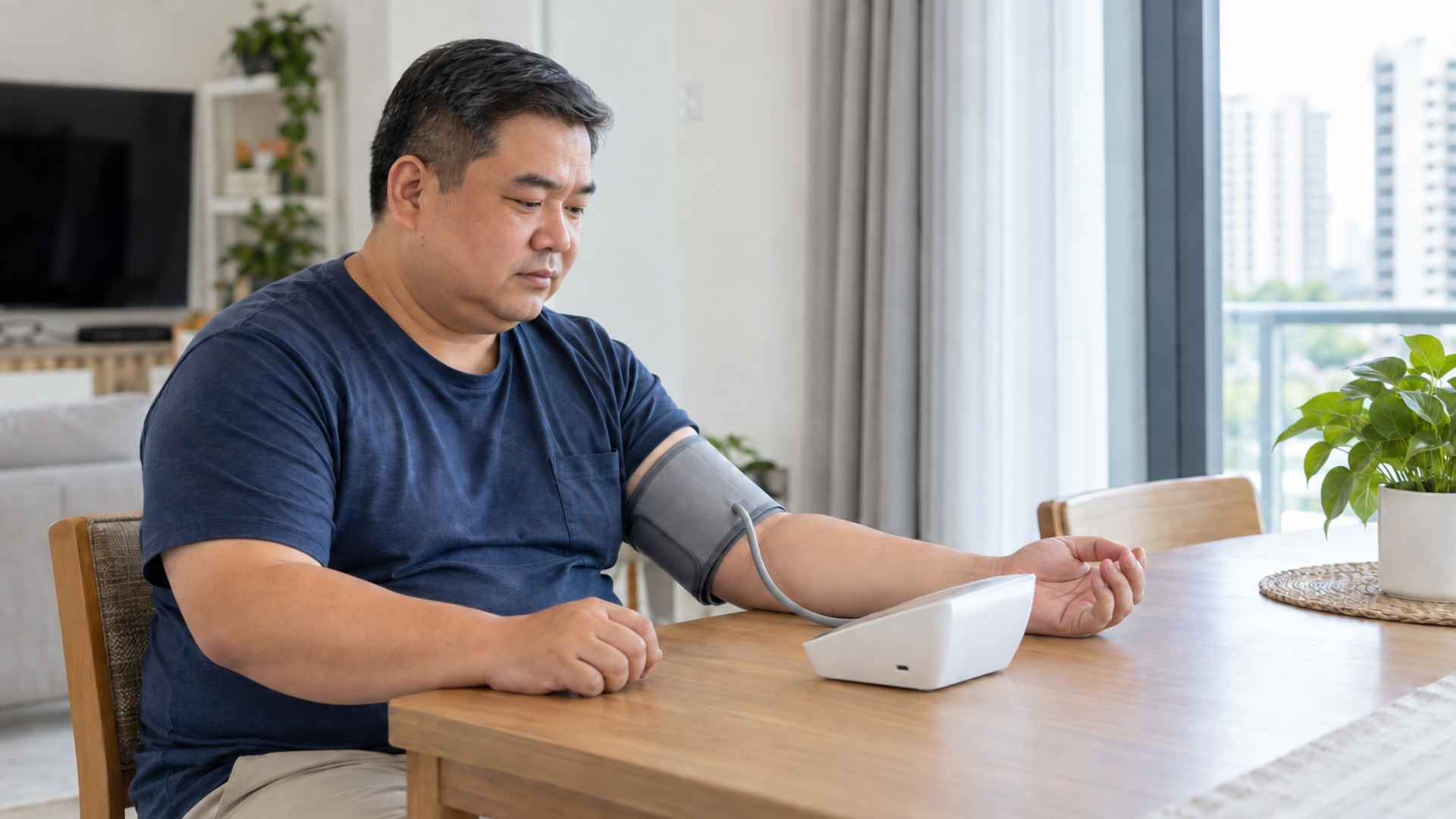
It can also help to track your weight and waist once a week, and your blood pressure if you have a home monitor. Use a cuff that fits your upper arm, because a cuff that is too small can give falsely high readings. Seeing the numbers side by side often shows how closely they move together. These are supportive measures, not substitutes for a proper diagnosis.
When Should You See a Doctor?
It is worth seeing a doctor if your BMI is 23 or higher, or your waist is above 90 cm for men or 80 cm for women, and you have not had your blood pressure checked in the past year. The same applies if a screening or pharmacy check shows a high-normal or high reading, or if you have tried to lose weight on your own without lasting success. A review is also sensible if you are already on blood pressure medication, your weight keeps rising, and your readings are not well controlled.
You do not need a referral to see a GP in Singapore about your weight or blood pressure. Regular health screening can pick up both early. For long-term care, eligible residents may be able to use MediSave under the Chronic Disease Management Programme, and CHAS or Healthier SG subsidies for selected chronic medications. If you ever notice the urgent warning signs listed earlier, such as chest pain or sudden weakness, go to the Emergency Department or call 995.
Conclusion
Obesity is one of the main reasons blood pressure rises, and in Singapore both are becoming more common. Excess weight, and visceral fat in particular, makes your heart work harder, causes your body to hold on to salt and water, and keeps your nervous system on alert. Because high blood pressure is usually silent, your waistline and weight trend are often the earlier warning signs. The same link that raises your risk can also work in your favour. Losing even 5% to 10% of your body weight, with support where needed, may help bring your blood pressure down and lower your long-term risk of heart disease and stroke.
Frequently Asked Questions
Does obesity cause high blood pressure?
Obesity is one of the strongest risk factors for high blood pressure. Research estimates that excess weight accounts for about 65% to 75% of the risk of primary hypertension. Excess body fat, especially around the abdomen, makes the heart pump more blood, activates hormones that retain salt and water, and increases nervous system activity. Not everyone with obesity develops high blood pressure, and genetics, age, and salt intake also play a part.
How much weight do I need to lose to lower my blood pressure?
There is no fixed amount, and results vary from person to person. Research published in the journal Hypertension found that systolic blood pressure dropped by about 1 mmHg for every kilogram of weight lost. Singapore’s primary care protocols suggest a first goal of losing 5% to 10% of your body weight over 6 to 12 months. Your doctor can help you set a realistic target.
Can high blood pressure be cured by losing weight?
For some people whose high blood pressure is closely tied to their weight, losing weight can bring readings back into the normal range, and a doctor may be able to reduce or stop medication over time. For others, weight loss lowers blood pressure but does not fully normalise it, because age, genetics, and other factors also play a role. Never stop medication on your own, and keep up regular monitoring either way.
Can I have high blood pressure if my weight is normal?
Yes. High blood pressure has many causes, including genetics, age, high salt intake, and kidney or hormonal conditions. Some people also have a normal BMI but carry excess visceral fat around their waist, which raises blood pressure risk. This is why doctors in Singapore check waist circumference as well as BMI, with 90 cm for men and 80 cm for women as the higher-risk thresholds.
What is the BMI cut-off for obesity in Singapore?
Singapore uses Asian-specific BMI cut-offs, which are lower than those used in many Western countries. A BMI of 18.5 to 22.9 is considered healthy. A BMI of 23 to 27.4 is linked to moderate health risk, while a BMI of 27.5 or above is linked to high risk. A waist of 90 cm or more in men, or 80 cm or more in women, also suggests higher risk.
Can I take weight loss medication if I have high blood pressure?
Possibly. In Singapore, prescription weight management medication may be considered if your BMI is 30 or above, or 27.5 to 29.9 with a weight-related condition such as high blood pressure. Some of these medicines can affect heart rate or blood pressure, so a doctor must assess your health and current medicines first. Medication is always used alongside diet, activity, and regular follow-up.
Can blood pressure medicine cause weight gain?
Most blood pressure medicines do not cause significant weight gain. Some older types have been linked to small amounts of weight gain in some people. If you notice your weight rising after starting a new medicine, speak to your doctor rather than stopping it on your own. Your doctor can check whether the medicine is the cause and whether another option would suit you better.
About DR+ Medical & Paincare
DR+ Medical & Paincare is a primary care GP clinic brand with 12 locations across Singapore’s heartland estates. DR+ clinics provide general practice services, GP-supervised weight management assessments, chronic disease management, and health screening, alongside a focus on pain management. DR+ is a Healthier SG enrolled clinic and participates in CHAS.
Medical Disclaimer
This article is intended for general informational purposes only and does not constitute medical advice. Please consult a qualified healthcare professional for diagnosis and treatment tailored to your individual condition.
Latest Articles