CONTENTS
Quick Answer:
Shoulder pain after a workout is often simply delayed onset muscle soreness (DOMS), which develops 24 to 72 hours after exercise and settles on its own within a few days. However, sharp pain during specific movements, weakness when lifting the arm, or pain that lingers beyond two weeks may point to rotator cuff strain, impingement, or tendinitis. Distinguishing ordinary soreness from an injury depends on the pain’s location, timing, and how it responds to rest.
You finish a solid session at the gym feeling strong, only for your shoulder to start aching by the time you get home. Or perhaps it is the next morning, and reaching for your toothbrush suddenly feels like a struggle. For many Singaporeans who train regularly at HIIT studios, CrossFit boxes, or the neighbourhood gym, shoulder pain after a workout is a familiar but confusing experience. Is it simply the soreness that comes with pushing your body, or is it something that needs attention?
The shoulder is unusual among joints because it trades stability for an enormous range of motion, which makes it one of the most commonly strained areas during upper body training. This article walks through why the shoulder is so vulnerable after exercise, the common causes of post-workout shoulder pain, how to interpret your symptoms, and when it is time to see a doctor rather than simply resting it off.
Understanding the Shoulder: Why This Joint Is So Prone to Post-Workout Pain
The shoulder is not a single joint but a coordinated system of bones, muscles, tendons, and ligaments working together. The ball-and-socket structure formed by the humerus (upper arm bone) and the shoulder blade allows movement in nearly every direction, but this mobility comes at the cost of natural stability. Four small muscles and their tendons, collectively known as the rotator cuff, do most of the work holding the joint in place during pressing, pulling, and overhead movements.
According to HealthHub (Ministry of Health Singapore), roughly one in three Singaporeans will experience shoulder pain at some point in their lives, making it one of the most common musculoskeletal complaints seen at GP clinics. Because the rotator cuff tendons pass through a narrow space beneath the tip of the shoulder blade, exercises involving overhead pressing, heavy pulling, or repetitive lifting place these structures under considerable stress, particularly when technique, warm-up, or recovery time are lacking.
What Causes Shoulder Pain After a Workout?
Shoulder pain after exercise can come from a normal training response or from an underlying strain. Understanding which category applies to you starts with recognising the common causes.
Delayed Onset Muscle Soreness (DOMS)
DOMS is the most common and least concerning cause of post-workout shoulder pain. It typically appears 24 to 72 hours after unfamiliar or intense exercise, caused by microscopic muscle fibre damage and the body’s natural repair response. DOMS produces a dull, generalised ache and mild stiffness, but it should not cause sharp pain, significant weakness, or joint instability, and it generally improves within three to five days.
Rotator Cuff Strain or Tendinitis
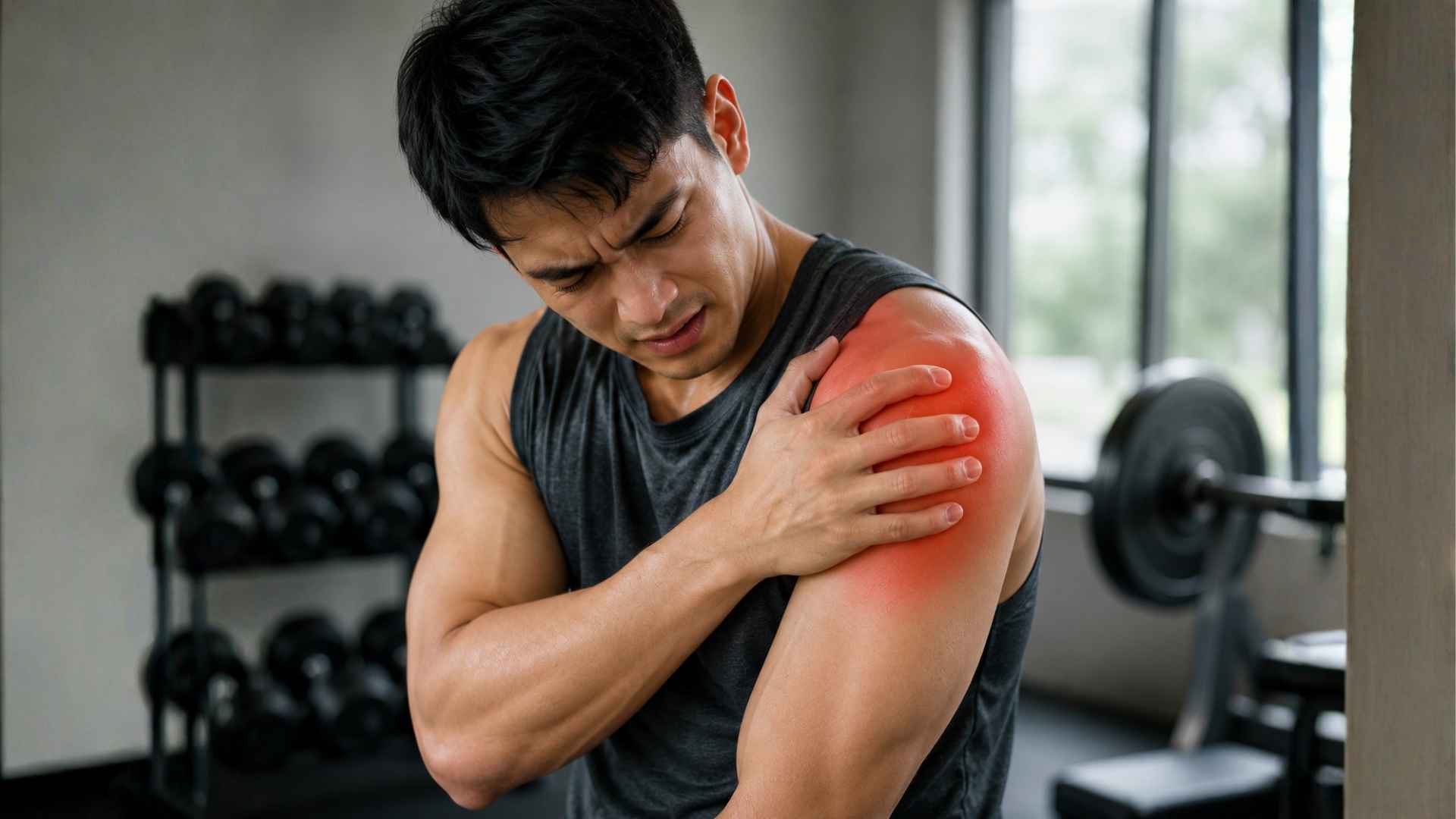
Repetitive overhead movements, such as shoulder presses, pull-ups, or swimming strokes, can irritate the rotator cuff tendons. This produces a more localised, sharp pain on the outer or top part of the shoulder, often worsening specifically when lifting the arm above shoulder height. Unlike DOMS, this pain tends to be reproducible with a specific movement rather than felt as general soreness.
Shoulder Impingement
Shoulder impingement occurs when the rotator cuff tendons become compressed as they pass through the narrow space beneath the acromion, often linked to poor scapular control or rounded shoulder posture during pressing exercises. It typically causes a pinching or catching sensation during specific arcs of arm movement, particularly between roughly 60 and 120 degrees of shoulder elevation.
Muscle Imbalance and Overtraining
Many training programmes emphasise chest and front deltoid exercises far more than the muscles of the upper back and rotator cuff. Over time, this imbalance changes how the shoulder blade moves, increasing stress on the front of the joint during pressing movements and contributing to recurring discomfort.
Poor Technique or Form
Lifting with excessive weight, rushing through repetitions, or allowing the shoulder to internally rotate during pressing movements can place unnecessary strain on the joint capsule and tendons. Technique errors tend to compound gradually, meaning the resulting pain often appears weeks into a training block rather than immediately.
Acromioclavicular (AC) Joint Strain
The AC joint, where the collarbone meets the top of the shoulder blade, can become irritated by heavy bench pressing, dips, or push-ups. Pain here is usually felt as a sharp, well-localised point directly on top of the shoulder, distinct from the broader ache of muscle soreness.
Bursitis
The bursa is a small fluid-filled sac that cushions the shoulder’s tendons and bones. Repeated overhead activity can inflame it, producing pain that closely resembles tendinitis and often worsens with continued overhead training.
Referred Pain from the Neck
Occasionally, shoulder pain that appears after a workout is not coming from the shoulder at all. Neck strain from poor positioning during heavy lifts, such as deadlifts or overhead presses, can refer pain into the shoulder and upper arm, which is one reason a proper clinical assessment matters when symptoms do not fit a typical shoulder pattern.
Where Does It Hurt? Interpreting Your Pain by Location
The location of your shoulder pain offers a useful, though not definitive, clue to its cause. Pain felt at the outer side of the shoulder, worsening when lifting the arm sideways or overhead, is typically associated with rotator cuff tendinitis or impingement. A sharp point of pain directly on top of the shoulder, at the junction with the collarbone, often points to AC joint strain, particularly if bench pressing or dips triggered it. A deep, generalised ache throughout the shoulder that improves with gentle movement is more consistent with ordinary muscle soreness. Pain that radiates from the neck down into the shoulder and arm, especially with associated tingling, suggests the neck rather than the shoulder joint itself may be the source. This is a general guide only, and it does not replace a proper clinical assessment where the exact structure involved needs to be confirmed.
Symptoms That Accompany Shoulder Pain After a Workout
Beyond the location of the pain, several accompanying symptoms carry diagnostic significance. A dull ache that eases with light movement and gradually fades over a few days is typical of ordinary soreness. Sharp pain that occurs consistently with a specific movement, such as reaching overhead or behind the back, suggests tendon or joint involvement rather than simple muscle fatigue. Swelling around the joint often indicates active inflammation, while a sensation of the shoulder catching, clicking, or feeling unstable during movement points toward a structural issue that warrants assessment rather than continued training through the discomfort.
Seek Prompt Attention If You Notice
- Sudden, severe pain following a specific injury or fall
- Visible deformity or the shoulder appearing out of place
- Complete inability to lift or move the arm
- Numbness, tingling, or weakness spreading down the arm
- Pain accompanied by fever or signs of infection
How Is Shoulder Pain After a Workout Diagnosed?
Diagnosis typically begins with a detailed history, including which exercises trigger the pain, when it started, and how it has changed over time. This is followed by a physical examination assessing range of motion, strength, and specific movements designed to reproduce the pain and identify which structure is involved. In many cases, a clinical assessment alone is sufficient to guide initial management. If the picture is unclear, if pain persists despite rest, or if a structural injury such as a tear is suspected, imaging such as an ultrasound or X-ray may be arranged to rule out other causes and confirm the diagnosis.
Shoulder Pain After Workout Treatment in Singapore: What Are Your Options?
Getting an accurate diagnosis first matters because treatment for muscle soreness looks very different from treatment for a tendon injury. You can read more about the range of shoulder conditions and how they are assessed on our shoulder pain page. In general, treatment follows a least-invasive-first approach, starting with rest and activity modification before progressing to more targeted interventions if symptoms persist.
Rest and Activity Modification
For straightforward soreness or mild strain, reducing training intensity for a few days while avoiding the specific movement that triggers pain is often enough to allow the tissue to settle. Complete inactivity is rarely necessary and may even slow recovery for milder cases.
Ice and Heat Application
Ice can help reduce inflammation and discomfort within the first 24 to 48 hours after pain begins, while heat may help ease stiffness and muscle tightness in the days that follow. Neither addresses an underlying structural injury, but both can provide symptomatic relief during recovery.
Physiotherapy
A structured physiotherapy programme can address the muscle imbalances, scapular control issues, and technique flaws that often underlie recurring shoulder pain. This is usually recommended for tendinitis, impingement, or ongoing pain that does not resolve with rest alone.
Coreflex Injections
For inflamed muscles, tendons, or joint tissue that has not responded to rest and physiotherapy, Coreflex injections combine local anaesthetic, anti-inflammatory medication, and muscle relaxants to reduce spasm and inflammation. Pain relief often begins soon after the injection, with fuller results typically noticeable over the following one to three weeks.
Platelet-Rich Plasma (PRP) Prolotherapy
For chronic tendon-related shoulder pain that has not improved with conservative treatment, PRP uses concentrated platelets from the patient’s own blood to stimulate the body’s natural healing response at the site of injury. Because it is derived from the patient’s own cells, the risk of allergic reaction is low.
Intra-Articular Injections
Where pain originates within the joint itself rather than the surrounding soft tissue, intra-articular injections deliver anti-inflammatory medication directly into the joint space to reduce pain and improve mobility.
Every treatment decision at DR+ starts with a proper assessment of which structure is affected, since injections are matched to the specific condition rather than applied as a blanket solution.
Doctor’s Insight
One pattern we see often in Singapore patients is the gym-goer who assumes every bout of post-workout shoulder pain is “just DOMS” because that is what happened the first few times they trained. The distinction we look for clinically is whether the pain is symmetric and generalised, consistent with soreness, or whether it is reproducible with one specific movement pattern, such as the top portion of an overhead press. The latter pattern usually indicates a tendon or joint structure under repeated mechanical stress rather than a normal adaptive response, and continuing to train through it tends to convert a mild irritation into a more established tendinitis over several weeks.
A second pattern worth flagging is the patient in their 40s and above who develops shoulder pain after resuming training following a period of inactivity. Tendon tissue loses some of its load tolerance with age and time away from training, so a training volume that felt manageable a decade earlier can be enough to trigger tendinitis or impingement in someone returning to the gym. The takeaway is straightforward: if shoulder pain after a workout is reproducible with a specific movement and does not ease within a week of reduced training, it is worth having it assessed rather than waiting to see if it resolves on its own, since early tendon irritation responds far better to treatment than an established chronic tendinopathy.
Managing Shoulder Pain After Workouts Day-to-Day: Practical Tips
A proper warm-up that includes dynamic shoulder mobility work, rather than a brief general cardio warm-up, prepares the joint for loaded movement and reduces strain on cold tendons. Gradually progressing training weight and volume rather than jumping straight into heavier loads gives tendons time to adapt. Balancing pressing exercises with pulling and upper back strengthening work helps correct the muscle imbalances that commonly contribute to shoulder pain. Reviewing technique, particularly for overhead and pressing movements, with a qualified trainer can catch form issues before they become a pattern. Allowing at least one full rest day between sessions that heavily load the shoulder gives tendons the recovery time they need. These are supportive measures, not substitutes for a proper diagnosis.
When Should You See a Doctor in Singapore?
Most cases of shoulder pain after a workout are mild and improve with a few days of modified activity. It is time to see a doctor if the pain is sharp and consistently triggered by a specific movement, if it persists beyond two weeks despite rest, if you notice weakness when lifting the arm, or if the pain disrupts your sleep or daily activities. No referral is needed to see a GP for shoulder pain in Singapore.
If your shoulder pain fits this pattern, speak to a pain-trained GP at DR+ for a proper assessment.
Conclusion
Shoulder pain after a workout sits on a spectrum, from the entirely normal soreness that comes with training hard to early signs of tendon irritation that deserve attention before they become chronic. Learning to distinguish a generalised ache from a sharp, movement-specific pain gives you a practical way to decide whether to rest and monitor, or to seek an assessment. If your shoulder pain is not settling the way you expect, a pain-trained GP at DR+ can help identify the underlying cause and guide you toward the right next step.
Learn more: Shoulder Pain | Shoulder Rotator Cuff Tendonitis
Frequently Asked Questions
What does shoulder pain after a workout usually mean?
In most cases, shoulder pain after a workout reflects delayed onset muscle soreness, a normal response to unfamiliar or intense exercise that develops within 24 to 72 hours and settles within a few days. It can also indicate rotator cuff strain, impingement, or AC joint irritation, particularly if the pain is sharp, localised, or consistently triggered by one specific movement rather than felt as general soreness.
Can shoulder pain after a workout go away on its own?
Ordinary muscle soreness typically resolves on its own within three to five days with rest and light movement. However, pain from tendon strain or impingement often does not fully resolve without addressing the underlying cause, and continuing to train through it can allow a minor irritation to progress into a more established injury over time.
What are the red flags to watch for after shoulder pain from exercise?
Seek prompt attention if you experience sudden severe pain after a specific injury, visible deformity around the shoulder, complete inability to move the arm, numbness or tingling spreading down the arm, or pain accompanied by fever. These signs suggest something beyond ordinary post-workout soreness.
What treatments are available for shoulder pain without surgery?
Non-surgical options range from rest, activity modification, and physiotherapy to targeted injections such as Coreflex, PRP prolotherapy, or intra-articular injections for cases that have not improved with conservative measures. These minimally invasive procedures are outpatient treatments with little to no downtime.
How is shoulder pain after a workout diagnosed at DR+?
DR+ doctors begin with a detailed history of your training pattern and symptoms, followed by a physical examination that tests range of motion, strength, and specific movements to identify which structure is affected. Imaging such as ultrasound may be arranged if the diagnosis is unclear or a structural injury is suspected, with treatment tailored to the specific cause identified.
About DR+ Medical & Paincare
DR+ Medical & Paincare (Doctor Plus) is a primary care GP clinic group under Singapore Paincare Holdings Limited, operating 12 clinics across Singapore. DR+ GPs are trained in the Painostic® methodology, enabling them to assess and manage a wide range of pain conditions alongside comprehensive GP and family medicine services. Minimally invasive Myospan procedures are available at all DR+ clinic locations. Walk-ins are welcome.
Medical Disclaimer: This article is intended for general informational purposes only and does not constitute medical advice. Please consult a qualified healthcare professional for diagnosis and treatment tailored to your individual condition.
Latest Articles