CONTENTS
Quick Answer:
Skin tags itch primarily because of friction against clothing, jewellery, or surrounding skin. In Singapore’s warm and humid climate, sweat trapped in skin folds worsens this irritation. A skin tag that is persistently itchy, changing in appearance, or bleeding without an obvious cause should be assessed by a doctor, who can confirm what the growth is, check whether it may be linked to an underlying health condition, and discuss appropriate removal options.
If a small, soft growth on your neck, armpit, or groin has started to itch, you are probably wondering whether it is a skin tag, whether it matters, and what to do about it. Skin tags are common in Singapore, particularly among adults over 40, and the itch they produce is rarely serious. However, it can be persistent enough to disrupt daily comfort, and in some cases, the pattern of skin tag formation may suggest something worth investigating medically.
This article covers why skin tags itch, what the pattern of your skin tags might signal about your broader health, how to tell a skin tag apart from other skin growths, and which type of doctor to consult in Singapore.
What Is a Skin Tag?
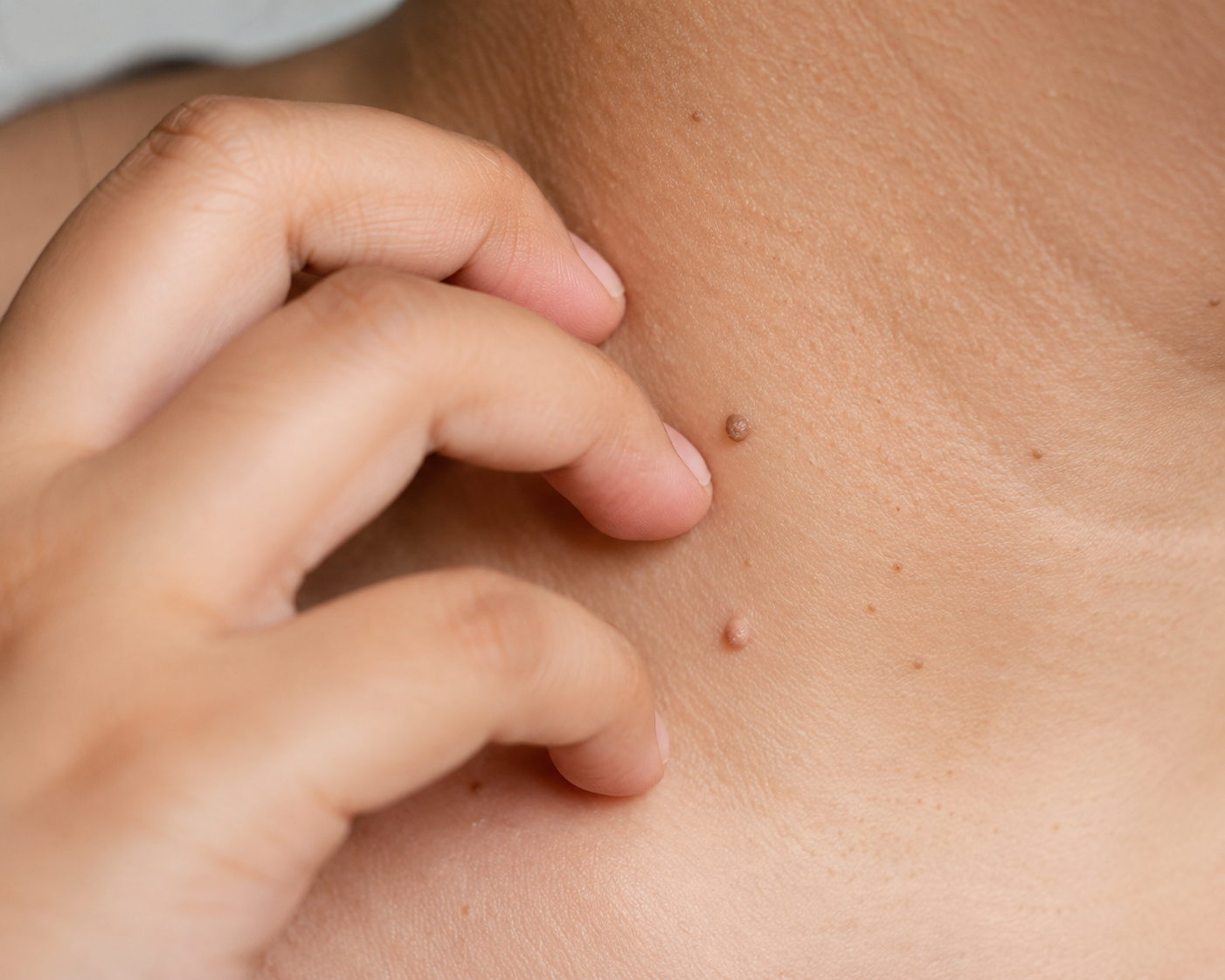
A skin tag, known medically as an acrochordon, is a small, soft, benign growth that hangs from the skin by a narrow stalk. It is made up of loosely arranged collagen fibres and blood vessels enclosed in a thin outer layer of skin. Most skin tags measure between 2 and 5 millimetres, though some grow larger. They are not cancerous, do not spread, and do not become cancerous.
Skin tags form most commonly where skin rubs against skin or against clothing repeatedly, which is why they tend to appear at the neck, underarms, groin, eyelids, and under the breasts. Clinical data from Singapore found skin tags in 37.1% of patients in one dermatology study, placing them among the most frequently encountered benign skin conditions in local clinics.
Why Are Skin Tags Itchy? The Main Causes
Friction Against Clothing and Jewellery
The most common reason a skin tag itches is mechanical friction. Because skin tags protrude from the skin on a narrow stalk, they are easily caught on shirt collars, necklines, bra straps, waistbands, and jewellery. Each time the fabric shifts or the body moves, the tag is tugged or rubbed. This repeated mechanical contact triggers a localised inflammatory response in the surrounding skin, producing the sensation of itching. Tags at the neck and underarms are particularly prone to this because of constant contact with clothing.
Sweat and Moisture in Skin Folds
Singapore’s warm and humid climate creates persistent moisture around skin folds. Tags in the armpits, groin, and under-breast areas sit in areas where sweat accumulates and cannot evaporate easily. Prolonged moisture contact softens the surrounding skin, a process called maceration, which lowers its irritation threshold. This explains why many people notice that their skin tag itch worsens during the middle of the day, after exercise, or during prolonged time outdoors.
Twisting or Torsion
A skin tag that becomes twisted around its stalk can have its blood supply temporarily disrupted. This is called torsion. The surrounding tissue responds with redness, swelling, and a noticeably sharper itch. In some cases, torsion causes the tissue within the tag to begin dying, which leads to more acute pain and discomfort. A tag that has undergone torsion should be assessed by a doctor rather than left or self-treated, as incomplete or unsterile removal carries infection risk.
Contact Dermatitis from Home Remedies
Apple cider vinegar, tea tree oil, garlic paste, and over-the-counter tag removal creams are commonly applied to skin tags in Singapore, often based on social media advice. None of these are formulated for skin tag tissue. They frequently cause contact dermatitis, a localised allergic or irritant skin reaction that produces redness, weeping, and significantly worsened itching. What starts as a mildly annoying tag can become an inflamed, raw patch of skin. Once contact dermatitis develops around a skin tag, the removal procedure itself may need to be deferred until the skin settles, making the overall process longer and more uncomfortable.
Dry Skin Around the Tag
Tags at the neck or eyelids, areas exposed to air-conditioned environments common in Singapore offices, shopping centres, and public transport, can itch because the surrounding skin has become dry and slightly scaly rather than because the tag itself is inflamed. The tag may be entirely intact, but the dry skin adjacent to it sends itch signals that feel as though they are coming from the growth itself.
Hormonal and Metabolic Factors
Skin tags are associated with hormonal changes including pregnancy, polycystic ovary syndrome (PCOS), and elevated insulin levels. Multiple skin tags forming progressively, especially in clusters at the neck and axillary folds, can be an early visible sign of insulin resistance. This matters because insulin resistance precedes type 2 diabetes, and skin tags have been identified in peer-reviewed literature as a potential cutaneous marker of metabolic dysfunction. Research suggests people with diabetes may be up to three times more likely to develop multiple skin tags than non-diabetic individuals. In Singapore, approximately 9.1% of residents aged 18 to 74 live with diabetes according to the Ministry of Health’s National Population Health Survey 2024, and one in three Singaporeans faces a lifetime risk of developing the condition.
The itching in this context is still caused by friction and moisture, not by the metabolic condition itself. However, the number and distribution of the tags can be a clinical signal worth taking seriously.
Can Itchy Skin Tags Signal an Underlying Medical Condition?
For most people, an itchy skin tag has a purely mechanical explanation. The growth is benign, and the itch is caused by friction or moisture. However, the pattern of skin tag formation across the body can occasionally reflect a systemic condition worth investigating. The distinction is between a single tag that has been caught on clothing and become irritated, and multiple tags appearing progressively in metabolically significant locations.
Insulin Resistance and Type 2 Diabetes
The most clinically significant association is between multiple skin tags and insulin resistance. When blood insulin levels are persistently elevated, they activate growth factors in skin cells that promote the formation of acrochordons. StatPearls, a peer-reviewed clinical reference from the National Institutes of Health, states that patients presenting with multiple or recurrent skin tags should undergo a thorough metabolic evaluation, including HbA1c, fasting blood glucose, and lipid profile testing.
In practice, the clinical picture that raises concern is multiple tags clustering at the posterior neck and axillary folds, particularly when accompanied by dark, velvety skin patches at those same sites, a condition called acanthosis nigricans, which is itself a recognised marker of insulin resistance.
Polycystic Ovary Syndrome (PCOS)
Women with PCOS often have underlying insulin resistance, and skin tags are a recognised dermatological manifestation of the condition. PCOS-related skin tags typically appear alongside other signs such as irregular menstrual cycles, unexplained weight gain, and acne. A doctor can assess whether these patterns together warrant investigation for hormonal or metabolic dysfunction.
Birt-Hogg-Dube Syndrome
Birt-Hogg-Dube (BHD) syndrome is a rare autosomal dominant genetic condition caused by mutations in the folliculin (FLCN) gene. It is characterised by benign skin lesions including fibrofolliculomas and acrochordons in the axillary region, pulmonary cysts, increased risk of spontaneous pneumothorax, and increased risk of renal cell carcinoma. The skin tags seen in BHD appear alongside other specific lesion types, and the syndrome is confirmed by genetic testing for FLCN mutations. BHD is uncommon, and the presence of ordinary skin tags alone is not a diagnostic marker. However, a patient with multiple atypical skin lesions and a personal or family history of renal tumours, lung cysts, or unexplained pneumothorax may warrant further investigation.
Pregnancy
Skin tags are common during pregnancy, particularly in the second and third trimesters, driven by elevated oestrogen and progesterone levels, weight gain, and increased skin friction. They often reduce or resolve after delivery. Itching during pregnancy is generally benign, but any persistent or widespread skin itch during pregnancy should be mentioned to an obstetrician, as it can occasionally indicate intrahepatic cholestasis of pregnancy, a liver condition that requires medical monitoring.
When Skin Tags Are Not a Warning Sign
The large majority of itchy skin tags do not indicate any underlying disease. A single tag on the neck that rubs on a collar, or a tag in the armpit that becomes damp in Singapore’s heat, has an entirely mechanical explanation. The concern arises when tags are multiple, appear progressively over weeks or months, and cluster in metabolically significant areas, particularly when accompanied by darkening skin creases, difficulty managing weight, or fatigue. If that pattern describes your situation, a medical assessment is a sensible and proportionate step.
Is It Actually a Skin Tag? How to Tell It Apart from Other Growths
Several other common skin growths can look or feel like skin tags, and it matters to distinguish between them because they require different approaches.
Warts are caused by the human papillomavirus (HPV) and have a rough, irregular, sometimes grainy surface. They are firmer than skin tags and do not hang on a stalk. Moles are typically flat or raised with defined edges and pigmentation that is more uniform or structured than a skin tag. Seborrhoeic keratoses have a distinctive waxy or warty surface and a stuck-on appearance. Dermatofibromas are firm, slightly indented nodules that feel fixed to the skin beneath rather than hanging freely. In rare cases, a growth that appears to be a skin tag may be a different type of lesion altogether that warrants a biopsy.
A doctor can distinguish between these clinically in most cases. If the growth has any of the features below, it should be assessed promptly rather than assumed to be a benign tag.
Seek medical assessment if your skin growth:
- Changes in shape, colour, or size over a short period
- Bleeds without being caught on clothing or jewellery
- Is persistently painful rather than just occasionally sore from friction
- Appears alongside dark, velvety skin patches at the same site
Is forming in clusters with new ones appearing over weeks or months.
Which Doctor Should You See for an Itchy Skin Tag in Singapore?
Several types of qualified doctors in Singapore can assess and remove skin tags. Understanding what each one offers helps you make the right choice for your situation.
General Practitioners (GPs)
GPs are registered medical doctors holding an MBBS or equivalent degree, licensed by the Singapore Medical Council. Skin tag assessment and removal by cryotherapy, electrocautery, or surgical excision with local anaesthetic falls within the scope of GP practice in Singapore, and many GP clinics offer these as routine outpatient procedures completed the same day. Because GP consultation fees are lower than specialist consultation fees, a GP clinic is often the most cost-appropriate starting point for a straightforward skin tag concern. GPs also function as primary care doctors responsible for ongoing health management. Under Singapore’s Healthier SG programme, enrolled patients maintain a long-term relationship with their GP family doctor, which means a consultation about skin tags can naturally sit alongside assessment of chronic conditions, metabolic risk, or other health concerns in the same visit. If the GP finds atypical features or suspects the growth is not a benign skin tag, they will refer you to a dermatologist or relevant specialist.
Dermatologists
Dermatologists are medical specialists with postgraduate training in skin, hair, and nail conditions. In Singapore, accredited dermatologists hold qualifications such as the MRCP (UK) and FAMS (Dermatology) and are registered as specialists with the SMC. They are the appropriate choice when a growth is changing rapidly, has atypical features, or when the diagnosis is uncertain. Dermatologists can perform skin biopsies and have access to dermoscopy for detailed lesion assessment. For a confirmed, typical skin tag with no atypical features, specialist-level assessment is generally not required, though it is a perfectly appropriate choice if that is the patient’s preference.
Aesthetic Doctors
Aesthetic medicine doctors are registered medical doctors who offer elective cosmetic procedures including skin tag removal using laser ablation, radiofrequency, or electrocautery. An aesthetic clinic is a suitable option for cosmetic removal of a confirmed skin tag when the patient has no uncertainty about the nature of the growth and no accompanying health concerns. Aesthetic doctors are not typically the primary choice when there is diagnostic uncertainty about what the growth is, or when the clinical picture raises questions about underlying health.
Choosing Based on Your Situation
For a single or small number of typical skin tags causing friction or cosmetic concern, with no diagnostic uncertainty and no signs of systemic conditions, any of the three doctor types above can help. A GP clinic offers the lowest consultation cost and the broadest health management context. For diagnostic uncertainty, atypical features, or complex skin history, a dermatologist is more appropriate. For straightforward cosmetic removal of a confirmed skin tag, an aesthetic clinic is a reasonable option.
A Doctor’s Perspective: What GPs See in Clinic
One recurring pattern in GP practice is the patient who has been applying home remedies to an itchy skin tag for months, only presenting when the surrounding skin becomes raw, weeping, or visibly inflamed. By this point the contact dermatitis caused by the home remedy needs to be treated first, and removal of the tag itself is often deferred until the skin heals. What would have been a short in-clinic procedure becomes a two-step process. The practical takeaway is that earlier assessment leads to simpler management.
A second pattern is worth describing. Patients occasionally come in with what they assume are a few harmless skin tags, but on examination the tags are clustering at the posterior neck and axillary folds, sometimes accompanied by subtle darkening of the skin creases. This distribution raises the clinical question of insulin resistance. At the same consultation, the GP can arrange an HbA1c blood test, which does not require fasting and gives a picture of average blood glucose over the preceding two to three months. If the HbA1c is elevated, the GP can then arrange a fasting glucose test on a subsequent visit to confirm the picture. Identifying prediabetes at this stage, before symptoms develop, gives patients a meaningful opportunity to modify their diet, weight, and activity before the condition progresses. This is a genuine example of the whole-person primary care role that a GP is trained and positioned to fulfil.
-Dr. Farah Khairi, DR+ Medical & Paincare Telok Blangah
What to Do While Waiting for Your Appointment
If your skin tag is itchy and you are waiting to see a doctor, a few practical measures can reduce discomfort in the meantime. Wearing loose, breathable clothing made from cotton or moisture-wicking fabrics reduces friction against the tag. Keeping skin folds dry after exercise or time outdoors limits the moisture that worsens irritation. Applying a fragrance-free moisturiser around the tag can help if the surrounding skin is dry. Removing or repositioning jewellery, watch straps, or bra straps that press directly on the tag reduces mechanical pulling.
Do not attempt to cut, tie, freeze, or apply acid-based products to the tag at home. These methods risk infection, incomplete removal, scarring, and worsened inflammation, and if the growth later needs a proper removal procedure, the surrounding damage can complicate it.
When to Seek Medical Assessment
You should see a doctor if your skin tag is persistently itchy and affecting your daily comfort, if it has been caught and is now tender, bleeding, or has changed in appearance, if you notice the growth changing in shape, colour, or size, or if you are developing multiple new skin tags over a short period. These are all reasonable indications for assessment, and none of them requires a specialist referral to get started.
DR+ Medical & Paincare has 12 clinic locations across Singapore’s residential estates, including Bishan, Tampines, Hougang, Ang Mo Kio, Boon Lay, Kovan, Marsiling, East Coast, Upper Thomson, Alexandra, Telok Blangah, and Pickering Street in the city. Walk-ins are welcome at all locations during operating hours. Speak to a DR+ doctor to get a clear assessment of your skin concern.
Conclusion
Most itchy skin tags are straightforward: a benign growth that has been caught on clothing or dampened by sweat. The itch is real but because the cause is mechanical, removal will resolve the symptom. The more clinically interesting question is whether a pattern of multiple skin tags forming progressively in metabolically significant locations reflects something worth investigating, and a doctor consultation is the right place to answer that question.
In Singapore, several types of doctors can assess and remove skin tags. The choice depends on the clinical situation. For a typical skin tag with no diagnostic uncertainty, a GP clinic is a practical and cost-appropriate starting point, particularly because GP consultation fees are lower than specialist fees, no referral is required, and a GP can address both the skin concern and any related health questions in the same consultation. Book a consultation with a DR+ Medical & Paincare doctor to get a proper assessment.
Read More: Minor Surgical Procedures
Frequently Asked Questions
Why is my skin tag suddenly itchy? Skin tags most often become itchy because of friction from clothing, jewellery, or skin rubbing in body folds. Singapore’s humid climate adds to this by trapping sweat and moisture around the tag. A sudden increase in itchiness can also happen if the tag has been snagged or twisted, temporarily disrupting blood flow to the stalk. If the itch is new, worsening, or accompanied by changes in the tag’s appearance, a doctor can assess whether it needs treatment.
Can a skin tag stop itching without treatment? If the source of friction is removed, for example by changing clothing or removing a piece of jewellery that was rubbing against it, mild itching may settle. The tag itself will not disappear on its own. If itching is persistent, worsening, or causing daily disruption, professional removal is the most reliable way to resolve it.
Can itchy skin tags signal a serious underlying health condition? For most people they do not. However, multiple skin tags forming progressively at the neck, armpits, and groin, particularly alongside dark velvety skin patches, can be associated with insulin resistance or prediabetes. In rare cases, skin tags appearing alongside specific other skin lesions and a family history of renal tumours or lung cysts may prompt a doctor to consider Birt-Hogg-Dube syndrome. If multiple new skin tags are appearing over a short period, a medical assessment is a sensible step.
Are itchy skin tags connected to diabetes? Multiple skin tags, especially those clustering at the neck and axillary folds, have been associated with insulin resistance and a higher likelihood of type 2 diabetes. Research suggests people with diabetes may be up to three times more likely to develop multiple skin tags compared to non-diabetic individuals. This does not mean skin tags diagnose diabetes, but it does mean that a cluster of new tags in these locations is worth discussing with a doctor, who can arrange appropriate blood tests.
Is home removal of a skin tag safe? Home removal methods, including cutting, tying, applying apple cider vinegar, or using over-the-counter removal creams, are not recommended. They carry real risks of infection, scarring, incomplete removal, and contact dermatitis. If the surrounding skin becomes inflamed from a home remedy, it can delay proper clinical removal. The safest approach is to have the tag assessed and removed by a doctor using sterile equipment in a clinical setting.
Which doctor should I see for a skin tag in Singapore? For a typical skin tag with no atypical features, a GP, dermatologist, or aesthetic doctor can all help. A GP clinic is generally the lowest-cost starting point and can also address any broader health questions raised by the skin tag pattern. A dermatologist is the right choice when there is diagnostic uncertainty, atypical features, or a need for biopsy. An aesthetic clinic suits patients seeking straightforward cosmetic removal of a confirmed skin tag with no other health concerns.
About DR+ Medical & Paincare
DR+ Medical & Paincare (Doctor Plus) is a primary care GP and pain management clinic group, part of Singapore Paincare Holdings Limited (SGX-listed). With 12 clinic locations across Singapore’s residential estates, DR+ provides comprehensive primary care, minor surgical procedures, health screening, and pain management services. Walk-ins are welcome at all locations. Hotline: +65 8777 9500 | drplus.com.sg
Medical Disclaimer
This article is intended for general informational purposes only and does not constitute medical advice. Please consult a qualified healthcare professional for diagnosis and treatment tailored to your individual condition.
Latest Articles